
My
interest in the history of Palanga park was aroused in the autumn of
1963 when the
discussion of the project of its restoration [1, 2]
demonstrated the lack of authentic information about the park and its
creators.
Fact finding
The first authentic data about the park
were obtained by digging the ground. In 1964 the rose-garden was
investigated by making furrows with a horse-plough. Fragments of gravel
paths were discovered, which enabled to recreate the path network [3].
In 1979 the flower-garden (Fr. fardin fleuriste) marked on the
plan by L (I b inset) was investigated likewise - students of the
Vilnius Academy of Fine Art dug ditches. Information was obtained about
the exnetwork of paths the route of the water supply pipeline and the
sites of pedestals (2, 3, 4 repr.).
The first important piece of information
on Palanga park was found by me in Paris. In 1983 I went to Paris as I
was participate in the international park project La Villette
competition. Walking along the paths of Buttes-Chaumont I noticed
concrete steps in the form of tree roots, which looked exactly like
those by the Palanga park pond (5 repr.). So I called on the Paris
Lithuanian Mr Petras Klimas, whose father had been up to 1940 Lithuanian
ambassador in France. I told him what I had seen in Buttes-Chaumont
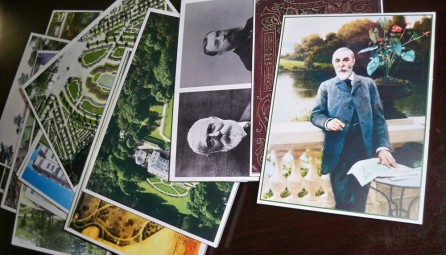
park, he in his turn showed me a coloured inset with the view of Palanga
park, which he had bought from a Parisian antiquary. The inscription on
this picture “Revue Horticole” brought the name of this magazine to
my mind. Being in Moscow in the winter of 1986 I found at the library of
the Botanical Gardens this magazine of 1906 with the above-mentioned
inset (I b inset) and the article of Rene E. André about the Palanga
park. It contains thorough information on the principles which underlie
Edouard André creative activity.
In 1984 at the IFLA congress in Siófok
(Hungary) I made the acquaintance of some colleagues from France.
Through the mediation of Mrs Frederique Tanguy of Angers I received in
1987 from Mr Daniel Lejeune, director of green plantations of Bourges,
two lists of Edouard André published projects, which he used as
visiting cards. The first list (6 items) names three parks designed in
Lithuania, at that time occupied by Russia, namely Traku Voke,
Uzutrakiai and Palanga, the second list (7 items) mentions the fourth -
Lentvaris.
In 1995 I got in touch with the Edouard
André Association and its president Mrs Florence André Kaeppelin, a
great grandniece of E. André. She gave to Palanga park excellent copies
of the plans of Palanga and Lentvaris parks. These ancient plans are
invaluable documents on the history of Lithuanian landscape architecture
and
unreplacable
material to park restorers.
On 15-17 April, 1998 I participated as an
invited guest at the expense of Edouard André Association in the
international colloquy “Landscape architect and botanist Edouard
André round the whole world”. There I obtained information about
Edouard André and his relatives, saw pieces of his creation and visited
his holding La Croix. Mrs F. André Kaeppelin gave to me several family
photographs and a few copies of letters of count Tiskevicius to E.
André [10, 11, repr.]
Annotations, evaluations, suggestions
Now we know about two visits of E. André
and his son Rene to Lithuania. That are the copies of the photographs
given to me by Mr. Laurent Penicaud, a great grandnephew of E. André
inscribed by the date June 18-27 1898 and the notebooks of René André
[13] from which we may learn about their visit in May, 1899. In the
course of this trip they visited two parks in the present Poland:
Samotszel (Polish Samostrzel) and Potulice, which are included in the
list of E. André most important works (6, 7 items).
The comparison of the authentic plan of
the park (I b inset) with the present park shows many deviations.
The plan bears the inscription in French
“Parc de la Birouta”. For hundreds of years the high sand dune of
the park and the forest surrounding it, which later became park, was
called Birute. In I960 the Soviet government named the park “botany”.
It still bears this name.
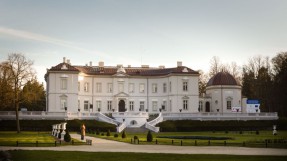
The parterre in front of the mansion has
no more pillars joined by garlands. The tennis court (E) is neglected
and overgrown with grass. The two arbours (D) (Fr. kiosque) are
gone. The only memory of the estate stables (B) is the drawing made by
architect Vladimiras Zubovas in 1947 (12 repr.).
If many of these things were recreated the
park would come alive. As we now have the authentic plan the
flower-garden can be easily recreated (L). According to the authentic
plan the flowerbeds should lie round the mansion and in the
flower-garden. Growing colourful flowers which are now being planted in
forest glades, along the paths and at random places should be given up.
I suggest that a new vase with a dedication inscription to Edouard
André be put on the ancient pedestal in the flower garden. That would
remind everybody of the projector of Palanga park.
The Lourd at the foot of Birute hill is
not foreseen in E. André plan. It was constructed on the initiative of
the owners of the park, as it was the fashion at that.time and one must
admit it being in harmony with the site. E. André did not plan a single
sculpture, at present there are seven in the park. Some of them are in
harmony with the park, marking the history of this site.
The statue of the “Blessing Christ” is
a problem. Instead of the vase originally planned in the flower-garden
was erected by wish of the park owners in the past and at the initiative
of some energetic people in the present a high metal figure dull and
lifeless, the sun being at its back. Thus the artistic harmony
prevailing between the mansion and the parterre was thoroughly changed
and may be distorted.
The wide-spread opinion that a beautiful
object suits always and everywhere is wrong. It may be proved by the
effect of the erection in I960 at the frontal entrance of Palanga park
of the sculpture “Egle the Queen of Grass-Snakes” by Robertas
Antinis (father). This excellent sculpture could become the centre of
composition of some new square, but an easier though wrong way was
taken.
By the insertion into the space of the old
park of the striking sculpture the scenery of the approach to the
mansion became changed, so does the sequence of the impressions of the
visitors of the park: the culmination being carried to the prologue. The
park was changed, reformed, its author, the great creator of parks,
mocked at.
The seekers of the authentity of the park
might dream that the “Blessing Christ” was moved to a church-yard
and “Egle the Queen of Grass-Snakes” would rule over an important
square of Palanga.
The creators of the park delighted in
Palanga forests René André has written: “We took care to leave in
the parts which are far away from the mansion the uneffected forest, to
preserve its severe and grand character” [6]. To go by him in many
places of the park the woods should not be thinned but thickened.
Palanga park is the best looked after park
in Lithuania. The new data about the park enable us to make it really
examplary.