
A
PARTIAL SURVEY OR RESEARCH ON PRE-NINETEENTH-CENTURY
LITHUANIAN AMBER ARTEFACTS (ARCHAEOLOGICAL FINDS)
Adolfas
Tautavičius
The nineteenth and early
twentieth-century custom of wearing a string of
amber beads with national folk costume, and songs and
poems about “amber tears” and “the land of amber”
made this material popular in Lithuania. We have taken
to calling Lithuania the “amber country”. However,
the question as to when people began to adorn
themselves with amber and when it took on the
significance of a “lucky stone” is still little
researched by Lithuanian scholars. The oldest,
pre-thirteenth century, period remains especially
poorly researched.
The
Stone Age
For a long time our most
important source of knowledge about this period was
the so-called “Juodkrante (Schwarzort) Amber Hoard”.
In 1858, after work began on mining amber from beneath
the Curonian Lagoon at this site, man-made amber
artefacts were also dredged up from the seabed. These
were collected and sent to the Stantien and Becker
Mining Company's museum in Königsberg. These finds
included pendants, beads and brooches and in 1865
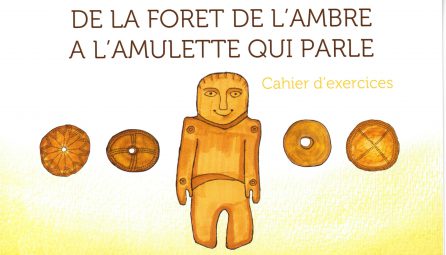
amber figurines of human beings were found [1]. By
1880 more than 400 finds had been collected. In 1882
this amber collection was described and published by
R. Klebs, who showed that these objects belong to the
Stone Age [2]. It should be added that by then amber
mining had led to such finds’ appearing in the
Tilsit and Strasburg museums and even in private
collections [3]. For a long time Schwarzort finds were
handed over to the University of Königsberg. In 1938
facsimiles of some human figurines and several other
artefacts were made for the Cultural Museum in Kaunas.
Between the wars Schwarzort finds were attributed to
comb-marked pottery culture [4] and were cited by many
authors writing about the Stone Age in Lithuania and
East Prussia [5]. In 1944, as the eastern front closed
in on Königsberg, the Schwarzort artefacts
disappeared. Only later were a dozen or so finds from
this collection tracked down in Gottingen. These
include the human figurines found off Juodkrante [6].
Another major collection
of similar ornaments (amber beads, pendants, buttons)
was found near Palanga by the Counts Tyszkiewicz. The
exact location and circumstances of their discovery
remain unknown. In 1908 a part of this collection was
donated to the Vilnius Society of the Friends of
Science (Towarzystwo Przyjaciól Nauk w Wilnie).
These finds are now in the Lithuanian National Museum
[7]. The Tyszkiewiczes gave the remainder of their
collection to the Kretinga Ethnographic Museum [8].
From there they eventually found their way into the
Cultural Museum in Kaunas. They were also dated to the
New Stone Age and attributed to comb-marked pottery
culture [9].
These two collections
from Juodkrante and Palanga were most important for
understanding stone-age ornaments. However, the
circumstances of how the Juodkrante hoard found its
way beneath the Curonian Lagoon remain unknown. We do
not know whether any other objects, such as animal
bones or potsherds, were found with them, because at
that time there was no interest in such objects.
Therefore, it is unclear whether this is just an amber
hoard, a sacrifice, or the remnants of a dwelling
site, or whether they were tossed into the Lagoon at
approximately the same time or over several hundred
years. Only recently has the thought occurred that
some of the Juodkrante finds might be older and others
more recent [10].
Apart from small studies
carried our in the late nineteenth and early-twentieth
centuries on the Curonian Spit, excavations of
stone-age dwelling sites began in Lithuania only in
the 1950s. At first sites in central and south-eastern
Lithuania were excavated. Remnants of settlements rich
in flint finds were investigated and so, when the
Stone Age in Lithuania was discussed, still only the
Juodkrante and Palanga finds were used in evidence [11].
The situation began to
change in 1966 when coastal sites at Sventoji were
investigated and later Nida (Curonian Spit) and other
sites were excavated. At Sventoji more than 20 pipe
beads, approximately 300 brooches, circa 100 pendants
and a dozen or so rings, disks, many trial pieces,
fragments and many off-cuts were found in addition to
pieces of raw material [12]. During excavations at
Nida in 1973-78 around forty amber artefacts were
found [13]. Furthermore, in sites excavated farther
from the coast only single amber artifacts or
fragments of artefacts were found [14] .
Therefore, it is now
clear that amber ornaments and amulets were known in
Lithuania from the Early Stone Age and that they are
found in sites belonging to the Narva and Rzucewo
(Pomorze) Culture [15]. It is thought that amber
artefacts in Lithuania spread not from only from
coastal areas, but that single objects also came from
eastern Latvia [16].
The Iron Age
We have no amber
artefacts from the first millennium BC, the end of the
Bronze Age and the early Iron Age, perhaps because
fewer people work on this period [17]. From the first
millennium AD and the beginning of the second
millennium our finds come almost solely from graves.
In barrows we find mostly unfashioned pieces of amber
(Ekete [Klaipeda District], Imbare [Kretinga
District], Juodonys [Rokiskis District], Mazulonys,
[Ignalina District] and so forth). Grave site
excavations have shown that amber beads were worn from
around the time of Christ, and from the third-fourth
centuries AD amber loom weights were used, which were
more common in Curonian and Zemaitijan dwelling sites
from the fifth-sixth centuries. In the eighth-ninth
centuries certain other amulets spread. However, it
should be added that this is only preliminary data
because most grave sites have been excavated only on a
small scale. Moreover, the material from the largest
grave sites excavated at the turn of the nineteenth
and twentieth centuries (at Anduliai [Kretinga
District], Oberhof, [Klaipeda District] and Vezaiciai
[Silute District]) was lost or disappeared unpublished
during World War Two.
During the first century
AD trade links developed between the south-eastern
Baltic littoral and the Roman Empire. Amber
consumption in the Empire was the reason why the first
information about amber and the Aesti tribes
(considered to be Balts) was included in the works of
Tacitus and Ptolomey [18]. Trade links with Rome and
her provinces provided the Balts with many non-ferrous
metal and glass-enamel beads. New nonferrous metal
(bronze, tin, silver) ornaments and glassenamel beads
became very popular among people living then in what
is now Lithuanian territory. Metal necklaces, spirals
and bronze pendants, coloured glass-enamel beads
became the main types of neck jewellery. Amber beads
were used more as amulets. Single amber beads are
included among other material in women's strings of
beads and they are also found in men's graves. They
have not attracted much attention in archaeological
studies [19].
In the fourth-sixth
centuries amber beads are more common and have more
varied forms [20]. Excavations of the Plinkaigalis
grave site have shown that at that time larger strings
of beads are found but only in graves where there are
no necklaces (Graves 24, 55, 56, 126) and various
forms of beads are found in strings from that time [21].
Most common finds are double-cut cones and spherical
beads while semi-circular and flattened circular forms
are rarer. Furthermore the surfaces of certain finds
are furrowed with concentric rings (some of which are
deep, some broader and almost unnoticeable), some are
incised, cut round, while others are carefully
polished and turned. We encounter pear or figure-8
shaped bead-pendants, some of which remind one of
beetles. Some forms are common in large European
areas. Some times they are discussed by archaeologists
from other countries, but Lithuanian finds are often
ignored or reported in small numbers because
Lithuanians fail to publish them.
Amber figure-eight
bead-pendants are found in south-eastern Sweden,
Denmark, Pomorze (Poland), East Prussia and to the
south east finds have been made in the Dnepr Delta [22].
Lithuanian finds are not marked on find maps. However,
such beads have been found in at least six grave sites
(Baitai, Gintarai, Prysmanciai and Uzpelkiai [Kretinga
District], Maudziorai [Kelme District], Zviliai
[Silale District]) [23]. Zviliai grave research has
shown that they were used as amulets [24].
The case with so-called
Bassonia-type beads is similar. Polish scholars who
have surveyed this type of turned bead and its
proliferation were able only to mention three find
sites in Lithuania, at Oberdorf, and Sernai in the
Klaipeda District and Eiguliai (Kaunas) [25]. R.V.
Sidrys collated other researchers' data concerning a
further sixteen find sites [26], although it seems
that there are very many more (grave sites at
Eiguliai, Paulaiciai, Stragnai and the Zvirbliai
barrows). However, it is typical that they are found
on strings together with amber beads of other shapes.
During the whole first
millennium AD most beads were used as amulets rather
than jewellery, as is illustrated by the frequency
(usually one-three beads together) with which they are
found in men's graves [27]. In eighth-tenth-century
Curonian graves single amber beads are found near
bits. From the fifth century two amber beads are more
commonly found in zemaitijan women's graves near pins
and near clasps in men's graves (two beads in a
grave). In Curonian men's graves we find two small
amber beads in the forehead region but, since organic
material tends to disappear for the most part, it is
unclear whether these beads were attached to the
corpse's hair or head dress. For example, in the
Palanga grave site (dated to the eighth-tenth
centuries) such grave goods are found with 32% of
corpses and at Bikavenai (Silale District) with 30% of
burials.
After cremation customs
spread in central and eastern Lithuania in the sixth
century and the practice became common in Skalvian and
Curonian lands in the seventh-eighth centuries less
and less data survives relating to the wearing of
amber beads and amulets. However, continued use of
amber is illustrated by finds from inhumation graves
with a horse (date: tenth-twelfth centuries) from
central Lithuania. Single beads are found above the
horse's head or by its neck. These were probably
attached to the horse's manes. We have examples of
this from at least ten graves. Lithuanian
archaeologists have not compared these finds with
amber discovered in human graves.
In Curonian men's graves
of the eighth-ninth centuries we come across
comb-shaped beads attached to a belt or placed in
another part of the grave. These are quadrangular or
semi-circular amber plates with schematically incised
“teeth” on one side [28]. In women's graves of the
same time we sometimes find a round amber plate above
the corpse's head; one side of the plate is polished.
The plates lack any holes for attachment and so it is
supposed that they were part of a head dress [29].
Furthermore, in women's graves we find symbolic tools
for weaving sashes (quadrangular amber plates, an
amber knife and some times a loom weight with a carved
stem) [30].
Hitherto amber loom
weights have received scant attention from
archaeologists [31]. They are found from the third
century onwards but are particularly typical of if the
first half of the first millennium and are found in
Curonian, Zemaitijan and Skalvian-Lamata territory.
That is, they are found in the same area where it was
a custom to place stone loom weights in women's
graves. In size and shape (a low cylinder) they do not
differ from stone weights. More than a hundred
examples have already been found in around thirty
graves. Only 10-11% of these finds are decorated in
the same way as stone weights. Sidrys considers these
to be ritual artefacts [32]. The frequency of amulets
and their classification as ritual artefacts has
forced archaeologists to consider this aspect of amber
usage [33].
As we see, we have no
single work covering Lithuanian amber artefacts. The
most important studies, we think, are those of Klebs,
Rimantiene and Sidrys. Amber production techniques,
changes in amber production, regional variations, the
amber and amber goods trade in the country remain
completely unresearched. These and other matters can
be studied only when we have a full catalogue of amber
finds in Lithuania. Not only excavation material but
also accidental finds preserved in all our museums or
mentioned in archaeological writing should be drawn
into this catalogue.
***
1 „Alrertumsfunde“, Altpreussische
Monatsschrift 2 (1865), p.755
2 R. Klebs, Der
Bernsteinschuck der Steinzeit von der Baggerai bei
Schwarzort und anderen Lokalitäten Preussens aus dem
Sammlungen der Firma Stantien und Becker und der
Physikalisch-ökonomischen Gesellschaft
(Königsberg,1882)
3 F. Siemering, „Über
Bernsteinfunde“, Mitteilungen der Litauischen
literarischen Gesellschaft 1887, vol. 2, p.
230-232; R. Forrer, „Neue Bernsteinscmückstücke
von Schwarzort“, Antiqua 1900 No. 1 / 2, p.
1-3
4 W. La Baume, „Bernstein“,
Reallexikon der Vorgeschichte I (Berlin, 1924),
p. 431-441; E. Sturms, „Schwarzort“, ibid XI
(Berlin, 1927), p. 373-379
5 W. La Baume, Urgeschichte
Ostpreussens (Königsberg, 1929), ill.32; B.
Richtofen, „Deutung der jungsteinzeitlichen
Bernsteinschnizerein vom Schwarzorter Stil“, Altpreussen
1935 part 1, p.3-15); C. Engel and W. La Baume, Kulturen
und Völker der Frühzeit im Preussenlande (Königsberg,
1937), p.36; J. Puzinas, „Naujausiu proistoriniu
tyrinejimu duomenys“, Senove IV (1938), p.
190.
6 E. Lausch, „Chatz in
der Schublade“, Stern 1977 No. 34, p.
110-112; S. Ritzkowski, „Das Schicksal der
Königsberger Bernsteinsammlung“, Muzeumkunde
XLII (2) (1977), p. 87-88; S. Ritzkowski and G.
Weisgerber, „Die neolitischen Bersteinartefakte der
Bernsteinsammlung der ehemaliger Albertus-Universität
zu Königsberg i. Pr.“, Investigations into amber
(Gdansk, 1999), p. 137-150; A. Gaigalas, Juodkrantes
gintaro lobio pedsakais“, Mokslas ir gyvenimas
2000 No, 12, p. 30-31
7 Lithuanian National
Museum, Archaeogical Section, AR 29: 114-140
8 B. Tarvydas, “Senoves
gintariniu papuosalu rinkinys”, Gimtasis krastas
1937 No. l, p. 36-46
9 Puzinas, “Naujausiu
proistoriniu”, p. 190-191
10 Ritzkowski and
Weisgerber, „Die neolitischen“, p. 139
P. Kulikauskas, „Gintaro
panaudojimas“, P. Kulikauskas, R. Kulikauskiene and
A. Tautavicius, Lietuvos archeologijos bruozai (Vilnius,
1961), p. 68-72
12 R. Rimantiene, Sventoji:
Narvos kulturos gyvenvietes (Vilnius, 1979), p.
87-103; eadem, Sventoji: Pamariu kulturos
gyvenvietes (Vilnius, 1980), p. 45-51; eadem, Akmens
amzius Lietuvoje (Vilnius, 1996), p.342
13 Eadem, Nida.
senuju baitu gyvenviete (Vilnius, 198 9), p.82-86
14 A. Butrimas, Akmens
amzius zemaiciu aukstumoje. Daktariskes gyvenviete
(Vilnius, 1982), table 33: 1-7; A. Girininkas, Kriatuonas.
Srednii I pozdnii neolit (Vilnius, 1990), p. 92,
ill. 115. 1-3
15 Rimantiene, Akmens
amzius p. 190-195, 286-290
16 Ibid., p.289;
Girininkas, Kriatuonas, p. 92
17 E. Grigalaviciene, Zalvario
ir ankstyvasis gelezies amzius Lietuvoje (Vilnius,
1995)
18 M. Michelbertas, “Prekybiniai
rysiai su Romos imperija”, Lietuvos gyventoju
prekybiniai rysiai I-XIII a. (Vilnius, 1972), p.
5-125
19 Idem, Senasis
gelezies amzius Lietuvoje (Vilnius, 1986), p. 106
20 V. Valatka, „Maudzioru
plokstinis kapinynas (1964 ir 1966 m. tyrinejimiu
duomenys)“, Lietuvos Archeologija. 3 (1984),
p. 19; V. Kazakevicius, Plinkaigilio kapinynas
[Lietuvos Archeologija 10] (Vilnius, 1993), p. 99
21 Ibid., ill. 100,
102:3, 162:4
22 M. B. Shchukin, “Sovremennoe
sostoianie gotskoi problemy i chernokhovskoi kultury”,
Arkheologicheski Sbornik 18 (1977), p. 85, ill.
4:8
23 R. V. Sidrys, “Vakaru
baltu gintaro ikapes gelezies amziuje”, Klaipedos
miesto ir regiono archeologijos ir istorijos problemos
[Acta Historica Universitatis Klaipedensis 2]
(Klaipeda, 1994), p. 69
24 L. Vaitkunskiene, Zviliu
kapinynas [Lietuvos Archeologija 17] (Vilnius,
1999), p. 164-165
25 J. Zak, Studia nad
kontaktami handłowymi społeczeństw
zachodnio-slowiańskich od VI do VIII w. n. e.
(Wrocław-Warsaw, 1962), p. 168-191; P. Wielowejski,
“Skarb bursztynu z póznego okresu rzymskiego
odkryty w miejsowśosci Basonia, woj. Lubelskie“, Prace
museum ziemi 41 (1991), p. 101-133
26 R. V. Sidrys, „Gintaro
ikapes senojo ir vidurinio gelezies amziaus kapuose“,
Vidurio Lietuvos archeologija(Vilnius, 1994),
p. 36-37, ill. 10
27 R. V. Sidrys, „Vakaru
baltu gintaro ikapes“, p. 91, table 1
28 Lietuviu liaudies
menas. Senoves lietuviu papuosalai, ed. R.
Kulikauskiene and R. Rimantiene (Vilnius, 1966), vol.
2, ill. 37-39; A. Varnas, „Gintaro apdirbimas“, Lietuviu
materialine kultura IX-XIII amziuje vol. 1
(Vilnius, 1978), ill. 5
29 Ibid., p. 181
30 Ibid., p. 120
31 Ibid., p. 119-120; A.
Tautavicius, Vidurinis gelezies amzius (Vilnius,
1996), p. 125-126
32 Sidrys, “Vakaru
baltu gintaro ikapes”, p.72
33 L. Vaitkunskiene, “Gintaras
- laimes akmuo”, Mokslas ir gyvenimas 1983
No. 3, p. 8-9; eadem, “Amber in the art and religion
of the ancient Balts”, Contacts across the Baltic
sea during the late Iron Age (5th-12th centuries).
Baltic Sea Conference, Lund, October 25-27, 1991 (Lund,
1992), p. 49-57; eadem, ”Gintaras senoves baltu mene”,
Ikikrikscioniskos Lietuvos kultura (Vilnius,
1992), p. 36-49
Prepared by: Tautavičius
A. A partial survey or research on
pre-nineteenth-century Lithuanian amber artefacts
(archaeological finds) // Baltic Amber / edited by
Adomas Butrimas. - Vilnius: Publishing Office of Vilnius
Academy of Fine Arts, 2001. P. 281-284.