
|
LITHUANIAN
APPLIED DECORATIVE ARTS OF 20th: AMBER
Lilijana
Nataleviciene
Until
World War One
production of amber in Europe was distributed in the
following way: Germany 33 % of world production, Russia 30
%, Austria 24 %, France 4 %, Turkey 2 %, other countries 7
%. Amber production in Lithuania, as a constituent of the
Russian Empire, was reckoned in Russia’s volume. The
masters of Palanga took the first place in Russia processing
20 thousand kg of raw amber annually. Before World War One
in Palanga all in all were from 300 to 500 amber masters.
The biggest workshops belonged to earl Tiskevicius in whose
lands the small town was establishing. Articles of amber
masters from Palanga were in big demand in the international
market and competed with those of German masters.
During
World War One amber workshops in Palanga suffered
losses. Some masters emigrated to Germany and Konigsberg.
Later amber processing in Palanga never reached the prewar
level by artistry and quality. The Germany’s monopoly for
use of raw amber barred development. Prices and volume of
imported raw amber depended on Germany (in Lithuania amber
was found in insufficient quantity). Amber workshops
operated not only in Palanga but also in Klaipeda and
Kretinga. Individual masters were scattered through whole
Lithuania. Bigger workshops were the following: in Klaipeda
- “Tanner and Friedman Enterprise” (20-30 masters
employed), in Palanga - “S. Gutman Successors E. and L.
Gutman” (10-15 masters) and the Workshop of Brothers M.
and G. Kann (10-20masters). Workshops with less than 4
masters were considered to be craft workshops and were not
inventoried.
In
prewar period amber workshops produced jewelry
(brooches, necklaces, bracelets), cufflinks, cigarette
holders, penholders, inkpots. Amber was used for
incrustation of metal adornments, wooden boxes, furniture
and other articles. Jewelry usually was of classic,
unsophisticated form - necklaces of round beads of various
size and length, brooches of polished amber, bracelets of
glassy squares. Amber jewelry was in big demand in
Lithuania. Every Lithuanian woman had to wear amber
adornments, expensive as they were. 60-70 % of homeland
production was realized domestically. After the world
recession of 1929 Lithuania’s production and export of
amber articles decreased.
In
forties-fifties amber articles occupied an important
place among other fine articles. In first postwar years they
were produced by the Kaunas workshop GINTARAS and since 1946
by the Klaipeda art factory DAILE with its amber processing
shops in Palanga and Plunge. Ground and polished necklaces
and various brooches (often in form of naturalistic plants),
animal-shaped souvenirs made up the main line of articles.
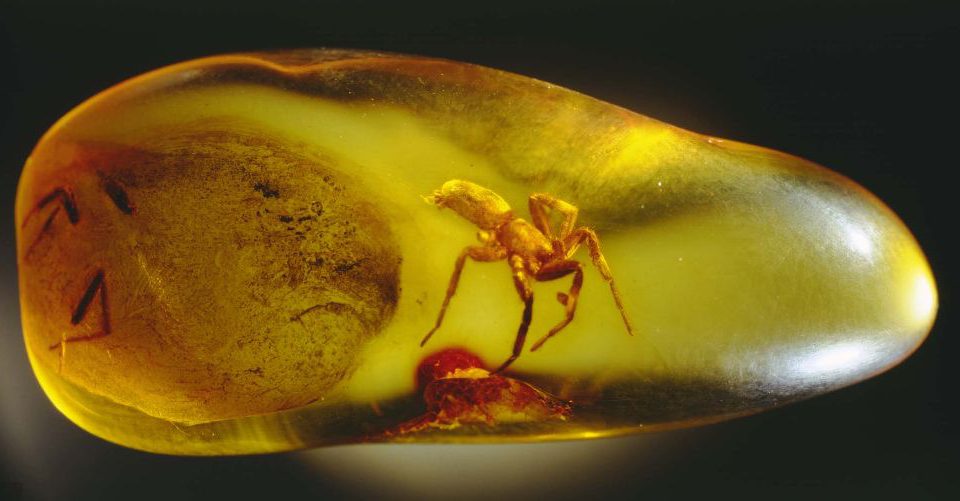
Amber was polished in angular form as precious stones. Amber
pieces with interesting inner texture or inclusions were
regarded as non-standard.
Feliksas
Daukantas, the sculptor and designer, played a
significant role in improvement of artistry of amber
articles. He was the first to stress natural amber
properties - transparency, changing nuances of color, its
many layers - and to restore specificity intrinsic to amber.
This artist also designed articles out of leather and metal,
but his most significant works of fifties were in amber:
unique or serial adornments combined with metal, mostly
silver. He minimally processed amber pieces used for
jewelry. Irregular amber pieces in brooches, necklaces,
earrings emphasized natural form, inner layers, transparency
or opacity of amber (set of solid jewelry in light opaque
amber, 1958).
In
1957 production of amber in Lithuania concentrated
in the Klaipeda art factory DAILE where professional amber
artists were teamed up, such as Eugenijus Mikulevicius,
Genovaite Blazyte-Guntiene, Birute Jociute-Mikuleviciene,
Vace Kojalaviciute-Uzpaliene. Tnak to this fact, output of
amber articles increased, their line was continuously added.
In that period amber jewelry was dominating. Chainlets with
amber pendants were quite the go. Masters combined amber
with forged, compressed, cast or filigree metal.
Incrustations, mosaics of small format in amber were very
popular. In 1959 G. Blazyte-Guntiene was the first to
produce them out of polished amber strips or bigger pieces
of coarse facture. Later landscapes, figural scenes and even
portraits set on wooden board came into fashion. Beside
works of good artistry, there were many superficial,
salon-like works. After some time pictures, mosaics and
incrustations were taken out of production.
In
fifties a significant step was made to restore
specificity of amber articles, to look for new applications
of this semiprecious mineral and to impart the author’s
individual style to jewelry.
Between
1961 and 1975 of discussed period amber articles
were made taking cues from the theoretical and creative
activities of Feliksas Daukantas, from his theory of natural
amber presentation. As previously, amber jewelry was a
rather poorly developed sphere. However, Lithuanian
adornments underwent strong updating, due to the Estonian
school of jewelers, as since late fifties the Lithuanians
studied fine metal processing at the Estonian Art Institute
in Tallinn.
Further
development of amber jewelry was influenced by
creation of Kazimieras Simanonis (born in 1937). He finished
the Estonian Art Institute, the chair of fine metal, and
returned to Lithuania in 1965. His conception of jewelry
differed from that of Feliksas Daukantas who emphasized
minimalism, ascetism, democratic tendencies and potential
unification of metal details. K. Simanonis treated the piece
of jewelry as an object of luxury, representation, a thing
that is not worn everyday, but on special occasions only.
The artist revived craving, incrustation, filigree, the
silver boiling technique, applicable for minerals of
irregular form. Later this technique was experimented by
other designers of amber jewelry (L. Sulgaite, Birute
Mikuleviciene, P.Balcius, Feliksas Pakutinskas). K.
Simanonis drew inspiration in forms of nature. His articles
of jewelry are asymmetric, different-fractured, dynamic,
expressive (medallions, 1970). The tendencies of decoration
and representation intensified at the next stage of
development of jewelry. Lithuanian articles of jewelry were
exposed in international exhibitions such as “Expo’68”
in Montreal, the international exhibition of industry and
commerce of 1968 in London, “Expo’70” in Osaka. The
adornments by Milda Eitmontaite made of cast and toreutic
metal with amber earned the diploma in the biennial of
jewelry of 1971 in Jablanec (Yugoslavia). It was the first
high evaluation of Lithuanian jewelry. Between 1971 and 1974
the exhibitions of Lithuanian amber articles formed from
collections of the Palanga Amber Museum traveled through
Czechoslovakia, Germany, France, Hungary, Austria,
Switzerland, Finland, Sweden, Denmark, Italy.
In
mid seventies professional artists lost interest in
amber. It remained only in works of loyal artists, first of
all, Feliksas Daukantas (1915-1985) who further developed
the minimalist, designer-type, ascetic-form trend in
jewelry. At this stage he refused any decorating details and
composed jewelry only from an amber piece and metal ring,
chainlet or some other functional detail. In contradiction
to the earlier period, the artist polished amber fully and
cut it into designer’s geometric structures - circles,
squares which had nothing in common with forms found in
nature.
Eduardas
Daukantas (born in 1948) created amber jewelry as
well. The jewelry of that time by Kazimieras Simanonis who
worked in the Vilnius art factory DAILE was connected with
his job. Amber remained the main field of creation for the
artists employed in the Klaipeda art factory DAILE (Albina
Vertuliene, Petras Balcius, Nikolajus Zoludevas) and the
whole team of folk masters (the Pakutinskas, Irena and
Feliksas, Regina Andriekute, Jonas Liukaitis, Alfredas
Jonusas, Joana Martinkiene, Dionizas Varkalis).
In 1982
the republican exhibition of amber articles was opened
in the Museum. In 1986 the exposition of Museum was updated.
Some personal exhibitions were arranged there (of L.
Sulgaite, K. Simanonis, F. Daukantas, the Mikulevicius,
Birute and Eugenijus), the exhibition on serial works of the
Klaipeda art factory.
Between
1991 and 2001 Lithuanian artists ignored amber,
leaving it to folk masters. The latter retained historical
traditions of amber processing. Mainly they designed
necklaces, brooches, bracelets, neck adornments. Sometimes
professional jewelers (K. Simanonis, S. Virpilaitis) applied
amber in their works. However, very few devoted themselves
to amber. Birute Stulgaite (born in 1952) was among them. In
contrast to F. Daukantas and K. Simanonis, she did not
oppose this mineral to metal, but very organically
integrated it into entirety of article. She regarded amber
as whimsical and complicated material, hard to harmonize
with metal.
Lilijana Nataleviciene
Translated by Marija Valiene
|
|