
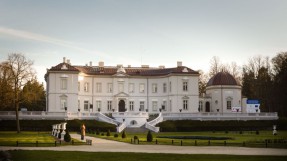
- PALANGA AMBER MUSEUM
Prepared by Antanas Tranyzas
Amber, that marvelous
creation of nature, attracted man since prehistoric times.
Glorified in songs and legends, made famous by poets and
scholars on Antiquity, it became part of the history of
human culture. Having
ossilized
and preserved in it self bits of flora and fauna which
existed tens of millions years ago, amber is prized not
only by beauty lovers but also is an object of scientific
studies. Found in many parts of the world, amber is
nowhere else so deeply rooted into everyday life, folklore
and art as in Lithuania. Thus it was not accidental that
the opening Amber Museums of Palanga in 1963 was met with
great enthusiasm. The opening of the museum was a
significant event not only for the people living on the
Baltic coast. It was a major even in the cultural life of
the whole Republic. In the course of 25 years a small
exposition occupying 96 square meters and containing only
478 items has grown into important center of amber
collecting, studying and popularizing. The exposition
displayed in the 15 halls of the mansion (total area 750
square meters) acquaints visitors with the origin and
processing traditions of amber. Due to syste The Museum is
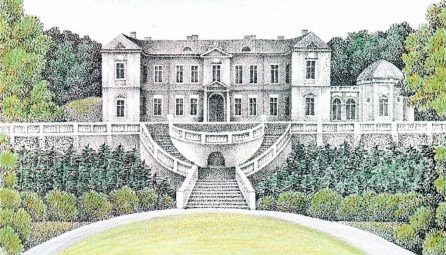
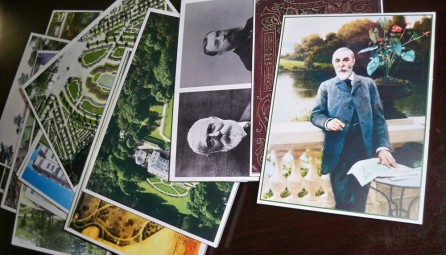
housed in the former mansion of count F. Tyszkiewicz
(built in 1897, architect F. Schwechten).matic work
carried out on scientific basis a rich collection
containing 25000 items has been accumulated. They are
being studied and systematized on the basis of perforated
cards system. The present exposition provides about 4500
carefully selected items surveying amber from two aspects:
1. The formation of amber in the process of the Earth's
evolution; 2. The role of amber in the history of culture.
The exposition was arranged according to the plan prepared
by R. Budrys, director of the Art Museum of the
Lithuanian. V. Katinas, scientific of geology and
mineralogy, provided scientific advice. Amber was
mentioned for the first time in the Assyrian cuneiforms in
the 10th century B. C. Ancient myths and legends reflect
man's attempts to solve the mystery of the origin of
amber. The Lithuanian legend about sea-goddess Jurate and
a fisherman Kastytis is the first attempt of Lithuanians
to explain the origin of amber. According to the legend
amber pieces are fragments of goddess Jurate's underwater
castle struck by Perkunas (the Thunder god) and her tears.
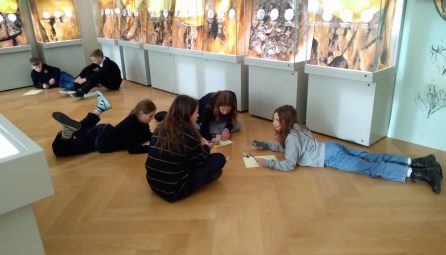
The exposition occupying the first floor reveals formation
processes of amber. The area of the "amber pine"
forest, climate, relief and hydrograph allow determining
conditions of amber formation processes. All this profound
and ample information is displayed in the showcases,
designed by architect V. Vizgirda. Amber (Lat. Succinum)
is fossil pine resin of the Eocene Period (I. E. 45 or 40
million years old), changed by microorganisms, oxidation,
polymerization and other processes. It formed in the
forests of coniferous and broad- leaf bearing trees, which
grew in Fennoscandia. The warming of the climate caused
increased resin Fennoscandia. The processes of amber
formation are well reflected by the shape of its pieces.
Morphological varieties of amber are divided into internal
(about 1 percent) and external (about 79 percent). In the
showcases are amply displayed intrawood, under rind and
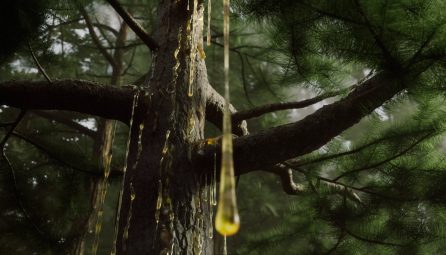
interring resin excretions, icicles, drops and
accumulations on trunks. From the scientific point of view
very interesting are micro drops and micro icicles
("amber in amber") i. e. fossilized first
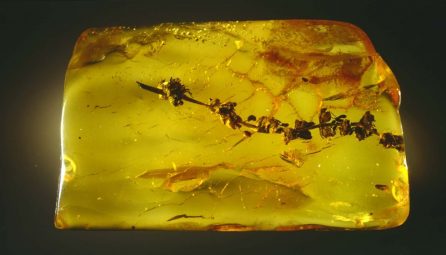
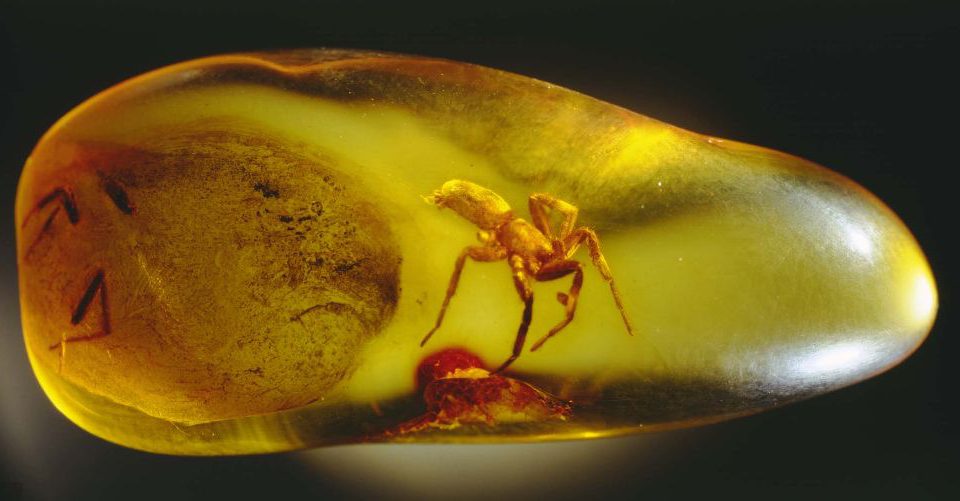
portions of resin excretions. Inclusions are fossilized
bits of flora and fauna of "amber pine" forests,
the ancestors of the present-day forests. 86.7 percent of
inclusions are insects, 11.8 percent are spiders, 0.1
percent is bits of plants and 1.3 percent is other group
of fauna. About 3000 species of fauna is fossilized in
amber. Well-preserved inclusions indicate that amber
originated from liquid resin, which was quickly hardening.
The Palanga Amber Museum has the collection of 15000
inclusions the study of which provides ample material for
the investigation of the history of amber and
million-year-old flora and fauna. On display are arthropod
inclusions: centipedes, arachnidan, ephemera, termite's
ants and others. The migration of amber started since its
formation and was going on throughout all geologic
periods. Complicated geologic processes which took place
in the Paleogene, Neogene and Quarter periods played an
important role not only for the spreading of amber but
also for the geologic structure of amber deposits and for
the formation of its diverse genetic types. The main amber
deposits formed in the Knigsberg region and Poland in the
deltaic deposits of rivers flowing from Fennoscandia in
the Eocene Period (45-50 million years ago). The
exposition presents geologic strata of amber deposit
molecule spectra and peculiarities of amber. It provides
the inner structure of amber, its range of colors and
processed products. Also on display are other fossil
resins found in the territory of the Sakhalin, Kamchatka,
Chukhotka, and Taimyr.
About 150 varieties of fossil resins (in Lat. Fossils
means excavated) are known all over the world. Most of
them occur in northern hemisphere, i. e. in Europe and
America, as these continents are well investigated
geologically. About 50 varieties of fossil resins dating
to various ages are found in Europe. Best known are
ruminate (Rumunia, the Carpathians) aykaite (Hungary),
simatite (Italy). In Asia occurs bur mite (Burma,
Thailand). Kindred to fossil resin copal dating from the
Quarter Period are found in Africa. Chemawinite (siderite)
is found in Alaska and Canada and fossil resins of broad
leaf-bearing trees calls "Mexican amber" are
found in Mexico and Dominica. As fossil resins possess
different chemical composition, properties and genesis,
they cannot be identified with amber. The unique shape of
amber pieces is a valuable material for morphologic
studies of amber as it reveals processes of resin
transformations. 70 samples of unprocessed amber from the
rich Museum collection are on display, including the
biggest piece weighing 3.698 kilograms. The exposition on
the ground floor reveals the history of the cognition and
application of amber. In 1860-1881 while mining amber in
the Curonian Lagoon, near Juodkrante, settlement unique
Stone Age artifacts were discovered which attracted
scientist's attention all over the world. This collection
was of utmost importance for studying the material culture
of our ancestors. As these valuable findings perished
during the wars, only their copies made according to
professor R. Kleb's study written in 1882 are on display.
The copies have been made by artists B. Kunkuliene.
Lithuanian sea coast (Palanga, Sventoji) yields numerous
amber artifacts dating to the Neolithic Period (4000-1600
millennium B. C.). Numerous amber artifacts are being
found in the gravers dating from the 1st-3rd century A. D.
Judging by the grave goods, amber played an important role
in the everyday life of our ancestors. During
archeological expeditions, the staff members of the Museum
collected about artifacts are found in western Lithuania,
the environs of Palanga included. Amber was used in many
spheres of human activity. The curative properties of
amber were described by the classic of Antique medicine
Galen (A. D. 180-190), Arab scientists Al Riz (A. D.
864-925) and Avicena (A. D. 980-1035), Dominican monk
Albert the Great (A. D. 1139-1200). Artistic processing of
amber flourished at the end of the 17th beginning of the
18th century. Such guilds functioned in Brgge, Lbeck,
Danzig, and Knigsberg. The biggest masterpiece amber was
the Amber Chamber (1709, architect A. Schlter, master G.
Turau), which during World War II was dismantled and taken
a way by Germans from the summer residence of the Russian
Tsar in Tsarskoye Selo (now Pushkin). In Lithuania amber
processing has old traditions too. On display is a 15th
century ring, a 16th century amber cross, amber jewelry
made by goldsmith P. Kilijonas of Kaunas dating to the
17th century. In Palanga amber workshops were functioning
already in the 17th century. At the end of the 18th
century they took the lead in amber industry in Russian
Empire. Before World War I about 2000 kilograms of raw
amber were processed in Palanga annually. They were not of
high artistic level. It was mainly round beads, various
brooches, cigarette holders, boxes, rosaries and others.
In the Republic nearly 500 artists are engaged in making
and designing amber jewelry and other artifacts. On
display are works by H. Taleikis, I. and F. Pakutinskas,
D. Varkalis, V. Kurklietiene and others. Modern
professional artists carry on successfully the
centuries-old traditions. All their efforts are directed
toward the revelation of natural qualities of each piece.
In this connection mention should be made of such artists
as Professor F. Daukantas, B. and E. Mikulevicius, L.
Sulgaite, P. Balcius, K. Simonaitis and others. Works of
Lithuanian artists were exhibited in such European
countries as Hungary, the GDR, France, Denmark, Finland
and others.
From the book "Palangos
gintaro muziejus". V., 1991. P 31-34
|
|