
- THE
STUDY OF AMBER PIECES WITH SEVERAL
INCLUSIONS
INSIDE
-
- Laima
Vaiciulyte,
- Palanga
amber museum (Lithuania)
-
The fauna, flora and
ecological conditions of the ancient Baltic amber
forest have been the object of study for more than a
century from quite different scientific points of
view. A good summary of nearly one hundred and fifty
years of scientific research on Baltic amber flora and
fauna has been published by Larsson S. G. (Larsson S.
G. 1978). In this monograph he tried to overview all
groups of flora and fauna from Baltic amber and
attempted to group them according to their living
environments and biology. Later, a short summary of
amber trees biotopes was done by Katinas V. (Katinas
V. 1983). More detailed overview of inclusions from
amber was published by Poinar G. O. (Poinar Jr. G. O.
1992). A controversial picture of amber forest has
been presented by Lourenco W. R. and Weitschat W.
(Lourenco W. R., Weitschat W. 1996). There they
explained why a fossil scorpion Palaeochylas balticus
(which has closest recent living relatives in the
tropical forests of South-East Asia, North Australia,
Indo-Malayan region and some parts of Africa) might
live in usually judged as subtropical or even
Palaearctic or Nearctic (Ander K., 1942) climate of
today amber forests. Baltic amber forest was immense,
covering large areas of what is now Scandinavia and
northern Europe almost to the Urals (Poinar G. O.,
1992, p. 265).
- In my work I will
classify amber pieces with groups of inclusions inside
(with more than seven inclusions) into three groups,
using a modified system of Larsson S. G., in order to
find out which part of the amber tree particular piece
of amber with inclusions has come from.
- Materials and methods
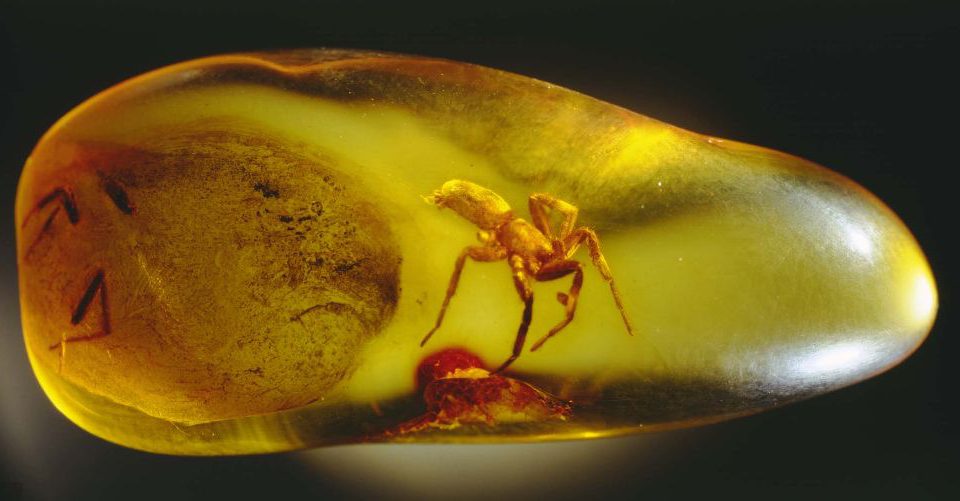
- About 3000 pieces with
inclusions from Palanga amber museum were
investigated, from which only 100 pieces of amber with
inclusions had more than seven inclusions inside.
Those were examined more detailed by binocular
microscope. Systematic position was determinate till
the level of families. Generally, in Baltic amber from
Palanga amber museum amber contains 1.3 inclusions per
piece. The biggest one examined by me has 95 specimens
of different inclusions inside.
- Description of zones
- A vertical layering can
be observed in an amber forest. Conditions of light
and humidity in this forest must have varied from the
base of a tree to the treetops. There can be separated
three zones in the amber forest: “Sciara” zone,
the tree-trunk zone and the crown of a tree zone.
- “Sciara” zone
- Among the amber fossils,
there is large number of one biological type from that
animal life which has been widely distributed in the
forest floor. This is the type of animal, which lives
larval live in rotting vegetation and adult's
existence free in the vegetation of the forest
undergrowth. The most characteristic representatives
are Diptera Sciaridae - fungus gnats. Others,
belonging to this wet, filled with mold-forming plant
material were Diptera Mycetophilidae, part of Diptera
Chironomidae, etc. Moss, liverwort, lichen, fungi were
abundant in this zone. (Katinas V. 1983, p.20-21).
- The fauna of moss and
bark with a great variety of groups also could be
found there.
- Diptera from families
Sciaridae, Mycetophilidae preferred wet, shadowed
undergrowth. Part of representatives from families
Empididae, Dolichopodidae hunted on them. Collembola,
Acarina, Pseudoscorpiones, Coleoptera Carabidae,
Silphidae, Embioptera, Dermatptera belonge to this
zone. Blatoides, Myriopoda, Formicidae were found
here.
- The tree trunk zone
- The fauna has been of a
different type of this shadowed, partly sunny, less
humid region.Mostly of Diptera were hound there. Part
of them was caught while resting, part of them while
feeding. This is the zone, which has contained many
spiders, Diptera Ceratopogonidae, Diptera Empididae,
Diptera Rhagionidae (Larsson S. G. 1978, p. 182). The
hidden fauna of tree trunks (Coleoptera Buprestidae,
Anobiidae, Mycetophagidae) belonged to this level.
- The fauna of the crown
of the amber trees (tree crown zone).
- Fossils, which with
certainty must have originated from the crown of the
amber trees, are unknown. Only some good fliers seed
and leave eaters, or nectar seekers may have belonged
to it. They were Apoides (bees), Diptera Tabanidae,
Syrphidae, part of Curculionidae (weevils).
-
- Results
- Several examples are
presented here.
- Amber piece No. ED 159
containing 20 inclusions and a piece of a lizard skin.
In this piece 55% of the fauna are from the “Sciara”
zone, 35 % - from the tree trunk zone and 10 % - from
an undetermined location (undeterminated larva,
Diptera Brachycera). The formation of such piece might
take place on the “Sciara” zone. The part of a
lizard skin also pointed to this.
- Piece of amber Ap.
14597, contains 95 inclusions in it. 61 of them are
Acarina - mites. 73 % of a fauna in this piece belong
to “Sciara” zone.
- Piece of amber Ap. 14580
contains 29 inclusions in it. 44 % of fauna belong to
“Sciara” zone, 38 % of them belong to tree trunk
zone, and 18 % are remnants and inclusions without
clear location.
- From the study of 100
specimen of amber pieces with several inclusions, 50 %
of them probably had been formed in the “Sciara”
zone, 40 % - in the tree - trunk zone, 2 % - in the
tree - crown zone and 8 % belonging equally to “Sciara”
and the tree trunk zones.
-
- Conclusions
- Pieces of amber with
several inclusions inside are quite rare. Most of
amber with inclusions was formed in the lower part of
an amber tree, in so-called “Sciara” zone.
- Some elements in amber
pieces determined as from the “Sciara” zone, are
from the tree trunk zone. It proves the flow of a
resin downwards, catching on its way bits of fauna and
flora from the different vertical levels. The biggest
excretion of a resin took place in the tree trunk
zone. There were no strong boundaries between vertical
levels. In order to receive more information,
systematic determination must be more detailed, to the
level of genus or species.
-
- References
- Ander K. Die
Insectenfauna des Baltischen Bernstein nebst damit
verknupften zoogeographischen problemen. - 1942,
Lunds. Univ. Aarskr. n. f. p. 85.
- Larsson S. G. Baltic
amber - a Palaeobiological study. - 1978,
Entomonograph, vol. 1. Scandinavian Science Press
Ltd., Klampenborg, Denmark.
- Lourenco W. R.,
Weitschat W. More than 120 years after its
description, the enigmatic status of the genus of the
Baltic amber scorpion “Tityus eogenus” MENGE, 1869
can finally be clarified. - 1996, Mitt. Geol.-Palaont.
Inst. Univ. Hamburg. Heft 79, s. 183-193.
- Katinas V. Baltijos
gintaras. - 1983, Vilnius, Mokslas. P. 19-46.
- Poinar Jr. G. O. Life in
amber. - 1992, Stanford University Press, California.
P.68-241.
-
- Prepared by: Vaiciulyte L.
The study of amber pieces with several inclusions inside
// Baltic Amber / edited by Adomas Butrimas. - Vilnius:
Publishing Office of Vilnius
- Academy of Fine Arts,
2001. P. 41-42.