
Summary
Inclusions help in investigations of many
biological, zoogeographical and palaeoecological questions. The inclusion
is not the hollow space in the amber. It is possible to find preserved
tissues there. The true colors of the inclusions are not preserved, but
pigmented spots on the wings and body sclerites are preserved. Most
inclusions are found in the clear flaky amber. Such amber formated, when
liquid resins constantly soaked from the tree wounds. Insects are the most
abundant group of all inclusions (86-92%), the second group are arachnids
(7.5-13%), animals of other groups form only 0.1-1.7%; plant inclusions
are very rare - only 0.4%.
Differences between recent and “amber”
forest's fauna usually are at the genus level, but species, which were
active during formation of amber are never met today.
The Palanga Amber Museum has one of the
biggest collections of fossiliferous amber in the world (14478 pieces),
when Kaliningrad Amber Museum's collection is rather small (1200 pieces).
The complex of crane flies found in the
Baltic amber (150 species) is related to the recent Holarctic fauna.
Formation of amber
inclusions
The complex of plant and animal inclusions,
which are found in the amber, is tied with the growing conditions and
distribution area of the amber trees. Probably that was not uniform
biotope, but was like a complex of different ecological conditions,
because there are samples of animals and plants found in amber, tied with
forests, swamps, bogs, meadows, mountains, lakes, rivers and other.
Investigations of amber inclusions help in evaluation of climatic,
geographical and other conditions of Eocenian / Oligocenian period.
Evolutionary conformities of separate animal and plant groups during
Cenozoic Era are found because of amber inclusions too. Ancestral and
close to them forms of many recent groups are found in amber too.
Inclusions help in investigations of many biological, zoogeographical and
palaeoecological questions.
Inclusions are known not only from Baltic
amber. They are also found in nearly 30 different kinds of fossil resins
with different ages. Inclusions are absent only in those fossil resins,
which occurred during formation of brown coal, and also in those, which
were produced in very small quantities (Kaunas, 1983). The small drops of
resin do not covered whole entrapped organism, and, due to contact with
atmosphere, it sooner or later disintegrated. Because of that, abundance
and diversity of inclusions in amber and other kinds of resins mostly
depends not on faunal and floral abundance and diversity of that period,
but, first of all, on the amount of produced resin.
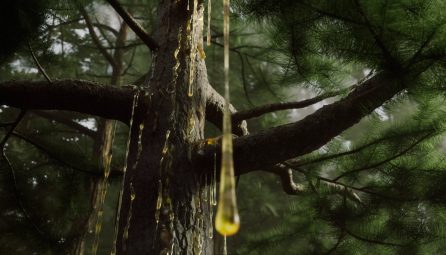
Usually plants and animals were entrapped
into the resin by the accident: they were blowed by the wind, soaked into
the liquid resins, resin drops slumped on them and similar. There are many
volatile terpenes in the resin, which usually intimidate insects and other
invertebrates. Most of insects, entrapped in amber, were alive. Only some
of them were already dead, dried out, teared by predators. Insects,
entrapped into the resin, died very quickly. Many of them are very well
preserved, even smallest details of their structure are seen: hairs,
pubescence or scales. Even such delicate structures as pubescent antennae
of midges (Chironomidae) are not sticked together in the amber. That
means, that secreted resins were very liquid, and hardened rather quickly
in the open air. Such delicate structures as wings and antennae would be
strongly deformed, if insects were entrapped in rather viscose medium. On
the other hand, such fragile and easy breakable structures as legs of
crane flies, often are found broken and scattered nearby the insect in the
same amber block. This could be because of flowing resins which broke
these legs, or that was a result of insects efforts to escape.
Insects and other small invertebrates were
preserved rather well in the resin, but bigger and softer parts of them
decomposed from inside and resulting gases were spread outside. They look
like white dust or white clouds around the body in the amber. Mostly such
white clouds are found around softest parts of inclusion like
intersegmental membranes, or close to its natural openings like mouth,
anus and spiracles. Such white exudes are covering taxonomically important
features of the specimen and usually it is very difficult or totally
impossible to see them. Sometimes it is possible to clarify them by
careful heating of amber piece under pressure or by autoclaving.
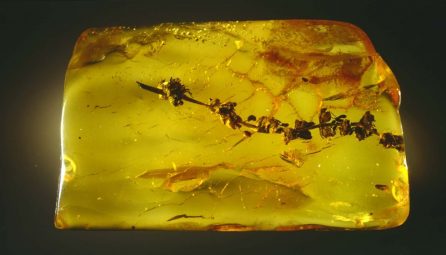
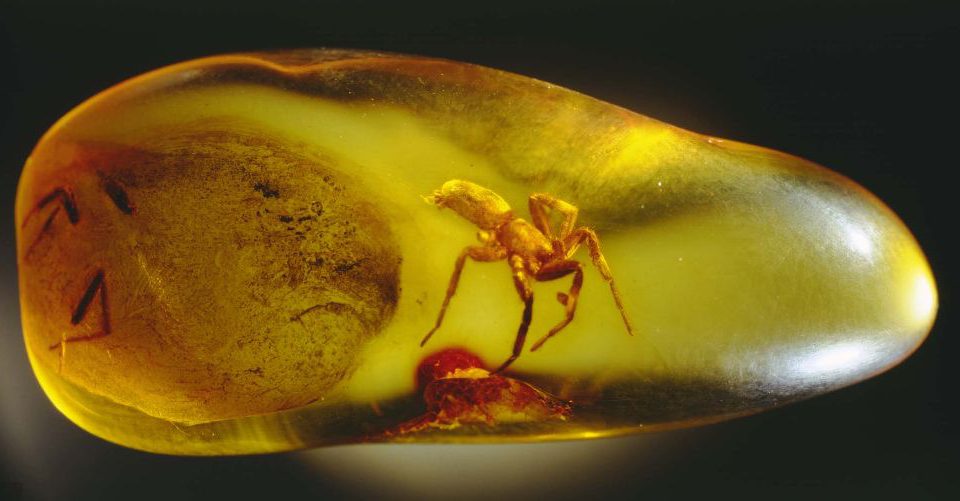
The inclusion is not the hollow space in the
amber having ideally preserved shape of the insect or other organism. It
is often possible to find preserved tissues or separate more chitinized
structures there. The true colors of the inclusions are not preserved and
all specimens have different shades of brown, but pigmented spots on the
wings and body sclerites are preserved - all specimens of the same species
have the same wing pattern.
Most inclusions are found in the clear flaky
amber. Such amber formatted, when liquid resins constantly soaked from the
tree wounds. Insects or plant fragments were caught into the older resin
and newly exuded layer covered them on the top. That's why most inclusions
are found in the flaky amber, and are very scarce in the solid and
especially unclear amber pieces. If new layer of resin was exuded after
longer period, entrapped insect or other creature usually was hurt by
bigger animals or mould grows.
Flaky amber forms 8-15 % of all amber
deposits. Inclusions are found in 41-87% pieces of flaky amber according
to different authors (Katinas, 1983; Klebs, 1887), but I would say, that
these numbers are much lower in reality. Amount of inclusions strongly
differs in separate deposits and in different places of the same deposit.
That is possibly tied with that, from where this amber was carried out by
the water - from forests or from their margins.
Insects are the most abundant of all
inclusions (86-92%), the second group are arachnids (7.5-13%), animals of
other groups form only 0.1-1.7%; plant inclusions are very rare - only
0.4% (according to the collections of different museums). Amber with tree
bark and pubescence of oak buds, which are found in most flaky amber
pieces are not counted. Systematic position of inclusions found in all
Baltic amber localities is very similar, but proportions of separate
systematic groups in different collections are very diverse. That's
because usually not all inclusions, found in the amber, are accumulated in
museums, but preferred are separate, more rarely found or impressive
groups, or it depends on specialists of separate systematic groups working
in the museum during the accumulation of the collections.
Systematic composition of inclusions do not
show real relationship of separate groups of organisms, which existed in
the “amber” forest, because many factors influenced preservation of
them in the resin. The main factor was size of an organism. The best
preserved are the smallest organisms and their parts. Bigger animals had
enough strength to escape. If they died in the amber, usually some parts
of them were not totally covered by the resin, and other animals or fungi
damaged them. Usually bigger organisms disintegrated from inside. Even in
the cases, when bigger organisms were totally covered by the resin, later,
during geological processes, some parts of them because of amber
oxidation, or due to rubbing with the surrounding substrate, became
exposed to the atmosphere and disintegrated. Usually only forest insects
had possibilities to fall into the resin. Water organisms and insects from
open localities are very rare. They were caught by the resins only
randomly.
Usually these organisms, which were active
during he driest season of the year, or were living in the driest places
are not found in the amber. That's because resins were exuded only in
spring and insects, flying during the other seasons had no chances to be
caught by them.
Differences between recent and “amber”
forest's fauna are nor very big at the family or even genus level, but
species, which were active at those geological times are never met today.
It is not very difficult to find similarities between “amber” and
recent fauna, because geologically amber is not very old - only about 40
million years (Poinar, 1992). Most evolutionary changes of faunal elements
were very slight during that period, even smaller changes were in their
ecological preferences.
The value of amber
inclusions and main collections
Amber has always been admired and valued for
its beauty as a gem. The value of amber, however, depends on whether it is
being appraised for public or scientific purposes. The public desires a
piece of beautiful color, polish, and form, whereas the biologist looks
for an interesting inclusion that can be clearly seen and examined. The
greatest commercial value of amber, for both the public and scientists,
comes from the inclusions it contains. From the biological standpoint, the
value of fossiliferous amber depends on the following (according to
Poinar, 1992):
1. The rarity of the inclusion. Most ants
and fungus gnats are fairly common in amber, and such common inclusions
are not as valuable as such rare ones as a flea or tick. Well-preserved
vertebrates, such as lizards and unusual arthropods like scorpions have
values tens of thousands times higher, than ants and fungus gnats.
2. The state of the inclusion's
preservation. The value, from both a scientific and aesthetic point of
view, is increased when a specimen is well preserved (in life-like form).
Frequently, a specimen will be partially disintegrated from microbial
activity, obstructed by milky deposits or mold, or “washed out” from
other causes. Fossils that are complete and can be identified are more
valuable than those that are incomplete and cannot.
3. The clarity of amber. Cloudy amber
usually obstructs the examination of inclusions, and air bubbles and other
deposits including organic debris may block the fossil from clear view.
Sometimes the obstruction can be ground away but this always involves the
risk of damaging the specimen.
4. The position of the inclusion. A specimen
positioned along the longitudinal axis of an oval piece of amber is more
easily seen than one positioned perpendicular to the axis (sometimes the
amber can be reshaped if fractures are not extensive). Some insects are
rolled up ventrally or wrapped around themselves, making identification
difficult.
5. The size of the inclusion. Anything large
enough to be distinctly seen without the aid of a hand lens will be
appealing to the public, but most insects enclosed in amber are small
(less than 5 mm long). From the scientific standpoint, size is important
only in its relation to the rarity of the inclusion. Because large insects
in amber are generally uncommon, species of large insects may be rare;
species of small insects can be just as rare, however.
Unfortunately for biologists, fossiliferous
amber does have popular appeal, and many rare fossils in amber bring high
prices from private collectors, thus eliminating them from study by
scientists. For this reason, the acquisition of fossiliferous amber by
various institutions should be encouraged. Most natural history museums
contain small collections of fossiliferous amber.
The assembly of many collections, biological
and otherwise, deposited in museums throughout the world, often stems from
the energy and finances of nonprofessionals, whose enthusiasm and finances
often allow them to gradually amass large collections. Almost all of the
significant collections of fossiliferous amber that have been deposited in
museums throughout the world and studied by experts have been amassed by
amateurs, many of whom were or are involved commercially in the sale of
amber.
Undoubtedly the largest assemble of amber
was the famous Stantien and Becker collection of Baltic amber originally
held at the Konigsberg University Geological Institute Museum in Samland
(Klebs, 1910). This collection included some 120000 animal and plant
fossils that had been gathered during the extensive amber mining
operations by Wilhelm Stantien, an innkeeper in Memel, and merchant
Moritz Becker. This venture started in 1860 (Ley, 1951). Over the years,
their collection of Baltic amber provided the great majority of specimens
used throughout the world for scientific study. It was feared that during
the Second World War the entire collection had been destroyed by bombing
(Wenzel, 1953); however, it was later learned that before the bombing, the
collection had been divided and deposited in various localities, with the
result that at least a portion of it was saved. Many private collections
of Baltic amber were either sold or lost during the war.
The biggest collections of
Baltic amber are:
British Museum of Natural History, London
25000 pieces
Museum of the Earth, Warsaw 25000 pieces
Zoological Institute, St. Petersburg 25000
pieces
Paleontology Museum, Humboldt University,
Berlin 20000 pieces
Museum of Comparative Zoology, Harvard
University,
Cambridge 16000 pieces
The Amber Museum, Palanga 14478 pieces
Institute for Geology and Paleontology,
Gottingen 11000 pieces
Zoological Museum, Copenhagen 7600 pieces
About two thirds of world amber reserves are
located on the Russian territory, nearly Jantarny village, Kaliningrad
region, but there are only about 1200 units in the Kaliningrad Amber
Museum's collection. This collection was created, mainly, according to a
principle of outward attractiveness, and serves as a basis for creating
expositions only (Ezhova, 1995). Any scientific investigations of that
collection are forbidden.
Recent investigations of
amber inclusions in Lithuania
The more intensive studies of Baltic amber
inclusions are not carried out in Lithuania now. That could be explained
by the bad financial situation of scientific institutions throughout the
country, but, first of all, I would say, it depends on the interests of
the scientists themselves. The only systematic works on amber inclusions
in Lithuania are those of dr. E. Budrys (1993), where he describes new
species of digger wasps (Hymenoptera, Sphecidae), and few publications by
the author, which were done just during the few last years. They are
assigned for the nematoceran flies (Diptera, Nematocera) of Baltic,
Dominican and Jordanian amber (Podenas, 1997; 1999 a; 1999 b; 1999 c; 1999
d; 2000 a; 2000 b; Podenas, Poinar, 1999).
Crane flies in the Baltic
amber (Diptera, Tipulomorpha)
Crane flies (Diptera: Cylindrotomidae,
Limoniidae, Pediciidae, Tipulidae and Trichoceridae) form only about 0.36%
of all inclusions, which are seen with naked eye (we are not counting
plant pubescence, which are found in most flaky amber pieces) (this number
is get by the author during the expertises of all amber with inclusions,
which are carried abroad from Lithuania through the customs, during the
calculations in the Department of Cultural Heritage, Ministry of Culture
of Lithuania). There are just slightly more than 2% of pieces with crane
flies in Palanga Amber museum's collections. More than 80% of all crane
flies belong to 2-3 commonest species Cheilotrichia minuta Meunier, 1899,
Trichoneura vulgaris Loew, 1850 and somewhat rarer Rhabdomastix
pulcherrima Meunier, 1906. The other rarer species form the rest part.
The complex of crane flies found in the
Baltic amher, without doubt, is related to the recent Holarcric fauna. 50%
of genera of crane flies from Baltic amber have Holarctic distribution
now; additionally more than 15% of genera are found in Holarctic and
Ethiopic regions; about 8% of genera are found only in Palaearctic; 23% of
genera are found throughout the world (cosmopolitic distribution) and only
less than 4% belong to genera with Neotropical distribution. So more than
95% of all genera found in the Baltic amber are "one's own".
Together there are paleotropical elements too - these are genera
Styringomyia, Toxorrhina and Trentepohlia. Alone species from those genera
were described in the middle of 19th and beginning of 20th centuries. But
there exist a possibility, that these species were described not from the
Baltic, but from Dominican amber. Most of the collections, which were
accumulated in the Konigsberg and in the museums of Germany before the
Second World War, disappeared, and to check these amber pieces and their
origin is impossible now. We had the possibility to check tens of
thousands of Baltic amber pieces with crane flies only, but we found no
one, even badly preserved specimen, belonging to these genera. On the
other hand, crane flies, belonging to these genera are very common in
Dominican amber (Podenas, Poinar, 1999). Similar situation is with the
genus Macromastix, which is found only in the recent fauna of southern
hemisphere (in Evenhuis, 1994 it is showed, that M. bornhardti Meunier,
1917 is described from the Oligocenic coals in France, when really it was
described from the amber). I would say, that the most unique Limoniidae
species in Baltic amber is Polymera magnifica Meunier, 1906. Recent
species belonging to that genus are found only in tropical and subtropical
America.
All species, known from the Baltic amber are
extinct today; there are extinct 13% of genera and additionally nearly 8%
of subgenera of recent genera. It could be seen, that differences between
Baltic amber and recent fauna aren't big, most often they are at the
species, and only sometimes at the genus or subgenus level. In some cases,
especially in the family Tipulidae, it is impossible to say to which
subgenus belong "amber" species, because they share features,
which are common for few recent subgenera and together they are somewhat
different too. Probably, differentiation into subgenera in that family
developed somewhat later and all recent subgenera are comparatively young.
Two genera described from Baltic amber,
later were found living. One of them is very common in the amber genus
Trichoneura Loew, the other - Styringomyia Loew, which probably was
described from Dominican and mistakenly ascribed to Baltic amber.
Besides the amber, the only crane flies from
the Lower Oligocene of Europe that are known are the interesting series
described by Cockerell (1921) and Cockerell and Haines (1921) from the
Bembridge beds at Gurnet Bay, Isle of Wight. A critical study of the
descriptions and figures fails to show that any of these species are
conspecific with those from the amber (Alexander, 1931). It is possible,
that the elapsed time between the deposition of the Bembridge beds and the
formation of the amber may have been few millions of years, a space of
time amply sufficient to allow of distinct speciation in the two
localities. List of species from the Bembridge beds adds one more
neotropical genus to the Oligocene of Europe.
Totally there are known 150 species of crane
flies from Baltic amber. These data are from the Catalogue of the Fossil
Flies of the World (Insecta: Diptera) (Evenhuis, 1994) with addition of
later described species. But some inaccuracies are left in this
"Catalogue", for example, same species are listed under separate
genera, because of different opinion of different authors; few species,
probably were described from Dominican and mistakenly ascribed to Baltic
amber; also there are species, which need to be counted as nomen nudum,
because they do not fit with the requirements of International Code of
Zoological Nomenclature (1999) - these are species, which, probably were
seen by nobody, and their names were automatically transferred from older
publications, where they were mentioned as such without descriptions,
illustrations or even designations of type specimens. There are not known
even museums or science establishments where these samples are preserved.
There are 25 species of crane flies described by the author from Baltic
amber.