
All the copious
literature on amber, including the oldest myths and
legends born in ancient times, reflects an ages-long
process of its investigation, leading from mystery to
knowledge.
Amber is one of the rare
creations of nature. As far back as hoary antiquity it
used to amaze the people's mind and to stimulate their
imagination by its mysterious specific properties.
Though as hard as stone, amber can be easily polished
and it would gleam in the rays of the sun with its
marvelous inner radiance. The things that caused the
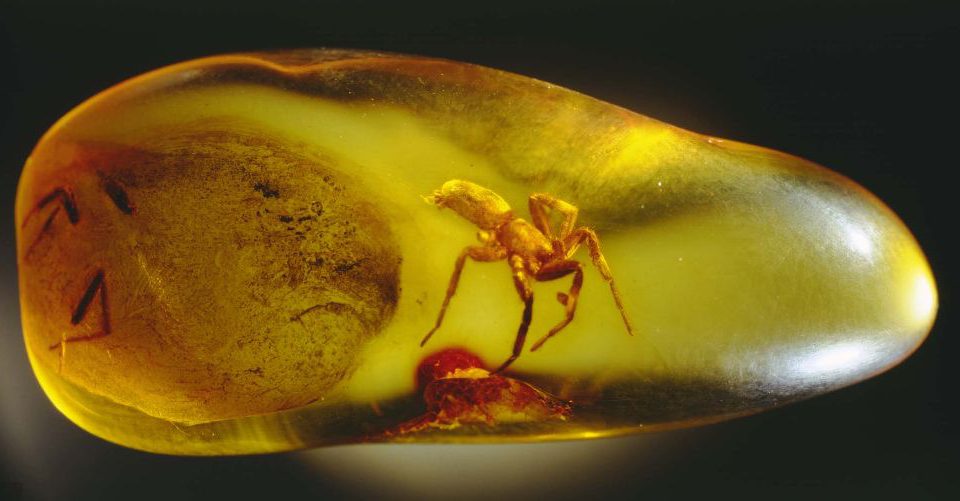
greatest wonder were various insects and fragments of
vegetation found in amber, completely the same as met
with in everyday environment. This might have been the
reason why amber was cloaked in a shroud of mystery
and mysticism from time immemorial.
Throughout ages
investigators made efforts to unveil that halo of
mystery. The first attempts are witnessed by ancient
myths and legends. Later on, amber drew the attention
of prominent ancient authors and poets. Thales of
Miletus was the first to describe electric properties
of amber, comparing them to magnet's tractive force,
and the famous Aristotle was the first who explicitly
highlighted a resinous origin of amber. The Greek
traveller Pytheus of Massilia after the greatest
travel in ancient times from the Mediterranean Sea to
the Scandinavian coast was the first to see and
describe the washed-ashore amber, which was found in
the sea grass by the natives and sold to their
neighbours Teutons. The latter used to deliver
it to Gallia, the final destination being Massilia. It
was Plinius Maior, a Roman historian, who gathered and
systematized the most exhaustive information on amber,
its origin, deposits and trade routes. When
generalizing the elucidations presented by a great
number of authors and the travellers' fantastic
stories, he was the first to expressly state that
amber had originated from the resin of pine trees.
Since the survived
written texts by ancient and early medieval authors
have not been consistently systematized up to the
present time, it is expedient to survey them in a more
consistent way.
Amber in
Ancient and Early Medieval Written Sources
“The Assyrian ruler
Ashur-nasir-apal sent his people to the Land of Amber,
where the seas wash amber ashore like copper...”
(Assyrian inscription on an obelisk (the British
Museum). Early 883, AD).
The earliest information
on amber can be found in various legends and tales,
which are usually referred to myths. The myths, which
emerged from folklore, reflect the efforts of the
people in primitive and tribal epochs to solve the
mystery of the origin of amber. In the epoch, when
people worshipped the phenomena of nature, amber was
also imbued with some supernatural properties. Its
articles were mainly used for worship purposes.
With the transition from
tribal to a slave-owning system, amber articles as the
symbol of nature worship (mainly the Sun's cult)
passed to the worship attributes of the rulers.
Ancient Egyptians used amber as an amulet or the
symbol of deity. It is witnessed by archaeological
finds from Chatenia (21st dynasty) and other
localities.
In the Aegean world
amber was also regarded to be the symbol of the Sun.
Its name Helektron was derived from the name of
the Sun-god Helector reaching Homer's times,
though its more ancient etymology was traced to the
Greek word Elek, meaning resin. In ancient
Greece this name (possibly borrowed from Phoenicians)
acquired the name of the mythologicalized Sun-deity Electron.
The oldest monument of
ancient literature that reached our epoch and where
mention of amber articles is made - HOMER'S (8th-7th
cent. BC) poem Odyssey. [1]
In Book 4 amber is
mentioned as the symbol of luxury in slave-owners'
palaces:
70. “Son of Nestor,
you who delight my heart, only look at the gleaming of
the bronze all through these echoing mansions, and the
gleaming of gold and amber, of silver and of ivory...”
(Transl. R. Lattimore).
In Book 15 amber is
mentioned as an object of trade. Here one discovers
that it was Phoenician merchants who used to bring
amber articles to ancient Greek towns:
415. “There came
Phoenician men, famous sea farers, gnawers at other
men's goods, with countless pretty things stored in
their black ship”. (Transl. R. Lattimore).
460. “... with a
golden necklace, and it was strung with pieces of
amber. Now in the hall the serving women with the lady
my mother were turning it in their hands and eying it
and offering...” (Transl. R. Lattimore).
In Book 18 amber
articles are mentioned as an expensive present for
one's beloved: 295. “Eurymacho's men came back with
an elaborate necklace of gold, strung with bits of
amber, and bright as sunshine.” (Transl. R.
Lattimore)
There is also a
narration from later epochs after Homer's hymn to
Apollo, where amber beads were promised to the goddess
Eileithyia. [2]
“... Iridis followed
the goddesses' advice and promised Eileithyia to give
her an elaborate, nine inches long, string of gold
beads decorated with amber in order to make Eileithyia
hurry to Delos”.
Another Greek poet
HESIODUS (8th cent. BC) in his poem Theogonia
describes Heracles' shield decorated with a piece of
shiny amber symbolizing the might of the Sun-deity.
In ancient scholarly
writings, the natural properties of amber were first
described by Thales of Miletus (640-546 BC), a
prominent philosopher, physicist and mathematician of
the early 6th century AD, called by the Greeks as one
of the seven sages of the world. He described a
specific peculiarity of polished amber - after rubbing
it, to attract small and light things. Thales was the
first to compare amber's traction with magnetic
properties. The word “electricity” was later
derived from this source. [3]
AESCHYLUS
(525-456 AD), a Greek tragic poet, was the first to
write down an ancient myth about the origin of amber.
Besides the elements of ancient religion, the
mentioned myth also reflects the rudiments of the
theory about the natural origin of amber. Its content
is as follows: “Once Phaeton, the son of Helios, got
permission to drive the Sun's chariot. He was boldly
driving the fiery chariot along the blue dome of
heaven. But the young man got dizzy in unfathomable
expanses, and his weak hands failed to bridle the
Sun's winged horses. The fiery chariot got so close to
the earth that the latter nearly caught fire.
When the heat reached
Olympus, the angry Zeus sent a lightning and Helios’
courageous son fell dead into the River Rohdamus.
Phaeton's sisters Heliades lamented for their brother
so much that the compassionate gods changed them into
black poplar trees ... and their unrestrained tears
turned into amber, which fell into the river and was
washed ashore by the waves. This is the origin of
amber.”
Later on, the myth about
Phaeton - the “shining”, the son of Phoebus (the
Sun's) and Clymene, reached us in the form of a
graceful poetic episode in the book Metamorphoses
by the Roman poet Publius OVIDIUS
Naso (43 BC-18 AD).
Another ancient legend
witnessing a fantasy-based origin of amber was written
down by the famous Greek tragedian
SOPHOCLES (497-406 BC) in his hook
Antigone:
1049. “Drops of amber
- the tears of mysterious Indian birds, Lamenting over
the death of the hero Meleager...” When surveying
the old authors' opinions on the origin of amber,
PLINIUS wondered in his days at Sophocles'
description: “How could have Indian birds lamented
over the hero killed on the land of Greece...” [4]
The secret of the
process of amber extraction must have been also
carefully kept by the merchants who transported it
from North Europe for barter trade. Even the prominent
Greek historian HERODOTUS
(484-425 BC), who widely travelled in Asia Minor,
Babylon, Egypt, Italy and Scythia (present-day
Ukraine), mentioning amber in his nine-volume treatise
The History of Greek-Persian Wars (Lib. 3, p.
115), wrote only a few sentences: “... amber gets to
Mediterranean countries together with tin from North
European countries. I have never met and seen a man
who had seen or heard of the amber (Elektron)
and tin (Kassiteros) extraction places...”
A more exact place of
amber extraction was pinpointed by Aristotle's
disciple THEOPHRASTUS
(372-287 BC) in his treatise on mineralogy.
Unfortunately ..., only a few short fragments have
reached our times. Plinius presents the following
quotation from them: Theophrastus informs that amber
is obtained from Liguria'. In Theophrastus' times,
Liguria was a very rich Greek province with its centre
Massilia, which was famous as a large trade centre. It
was from this city that the well-known traveller PYTHEAS
(4th cent. BC) started on his travel to the “Tin”
and “Amber” lands in 350-320 BC.
One of the greatest
geographical discoveries is associated with Pytheas'
legendary expedition, when a man of ancient
civilization forced his way as far as distant Thule
(present-day Norwegian shores). The disappearance of
his report on the journey is one of the greatest
losses suffered by geographical sources. Its survived
fragments specified veritable amber discovery places,
its extraction and trade routes. [5]
“Pytheas of Massilia
reports that Guiones, one of Germanic tribes, live in
an estuary called Metuonis stretching for 60000
stages. From there, it takes one a day to reach the
island of Abalus by sailboat. In the spring the waves
wash amber ashore together with all kinds of grass.
The grass is used as fuel instead of wood, and amber
is sold to their neighbours Teutons ... the Teutons
deliver it to the North-Gallic shores and from there
it gets to Massilia...”
The goal of Pytheas'
expedition to the Land of Amber - to collect reliable
information on the amber discovery places, hoping to
facilitate the transportation of these valuable goods
to Massilia in greater quantities. Greek scholars did
not believe in the truthfullness of Pytheas' report
and did not appreciate the importance of his scholarly
discoveries. Only later, it was geographical
discoveries that confirmed and rehabilitated the
scholarly significance of his expedition.
Another place from which
amber was transported in ancient times was mentioned
by the Greek author XENOPHON (about 430-355 BC) in his
book Helenica. Plinius informs: [6]
40. “... Xenophon says
that in Italia amber is called not only succinum
but also thium and by Scythians - sacrium,
because it was also transported from there...”
The application of amber
in medical practice goes back to ancient Greece. HIPPOCRATES
(460-377 BC), the father of Greek medicine, provided
in his treatises information on the healing
peculiarities of amber and the methods of its
application. This information was later made use of
not only by the Romans but also by early medieval
scholars. (In A. Aunfabers' monograph on amber (1551)
he quotes Hippocrates' information on amber in medical
practice).
Natural properties of
amber were described by EURIPIDES
(480-406 BC), a leading figure of the Greek drama, a
disciple of sophists. Speaking about various features
of amber, he highlighted its inner transparent gleam.
The outstanding philosopher PLATO
(427-347 BC) analysed similar properties of amber and
magnet in his work Timaeus.
Valuable ideas on the
origin of amber were set forth by ARISTOTLE
(384-322 BC), the greatest Greek scholar
and encyclopaedist, in his treatise Meteorologica
(L. G., p. 10). He was the first to mention a resinous
origin of amber: “... amber just as well as all
other bodies called “tears” originated from
hardening resin like myrrh incenses. The insects in
amber prove its formation by way of hardening...”
Mayron -
fragrant resin widely used in religious ceremonies,
medicine in Aristotle's days. [7]
“The bodies from which
all the moisture disappears (evaporates) are of an
earthly (natural) origin like ceramics or amber; ...
some of those bodies can be softened, e. g. amber...”
Due to the fact that
Aristotle's methodological starting point for the
studies of nature was physiology, exploring the laws
of the emergence, evolution and decay of a natural
body, he considered amber “tears” to be nothing
else but mere hardened tree resin.
PAUSANIAS
(2nd cent. BC), a Greek author and
traveller, who described a great number of famous
Greek cultural monuments, indicated in his work Graecial
descriptio [5. 10] that: “A shrine in Olympia
among a host of statues and frescos boasts one small
sculpture made of amber picturing the Emperor Augustus”.
Pausanias proceeded to
explain: “... amber is a very rare thing, therefore,
it is greatly valued. It is completely different from
the metal elektron - the gold and silver alloy.”
CALLISTRATUS
(mid 2nd cent. BC), a contemporary of Pausanias, also
showed his great enough concern for the peculiarities
of amber. He called one of its species, which
according to him “had a tint of gold and looked
particularly marvellous before noon, even strongly
attracting fire to itself (causing splitting)”, Chryselectron
(Chryselectrum = gold yellowish). He went on
saying that ... “nevertheless, tin and amber were
delivered to us from the North.” Later on, STRABO
(63 BC-17 AD), a Roman geographer and historian,
despite his criticism levelled at Phytheas' works,
acknowledged their truth that “... amber as one of
the products is delivered with Britannus tin and other
luxury things...” [IV. 5-2-5].
A more exact place of
amber extraction was pinpointed by another Roman
historian DIODORUS Siculus
(2nd half of the 1st cent. BC - 1st quarter of the 1st
cent. AD). He wrote in his Historical
Library:
“Straight to the North
of Scythia, beyond Gallia, is the Island of Basilia.
The waves wash ashore so-called amber, which nowhere
else can be found on earth ... Local inhabitants
gather amber and deliver it to the continent opposite
the island. From there amber is transported to our
lands...”
The Roman researcher PLINIUS
MAIOR (b. 23-d. 79 during the eruption of
Vesuvius) collected and systematized thorough
information on amber, its origin and the places of its
discovery.
A particularly great
scientific importance belongs to Plinius' work Naturalis
historia consisting of 37 books, which include
various pieces of information and fantastic
elucidations on the origin of amber collected by other
ancient authors and travellers. The work was published
by his cousin Plinius Caecilius Secundus.
Amber is mentioned in
Book 4 of the work:
97. “... Glaesaria
(the Island of Amber) was named by our soldiers,
because it was the place where amber was discovered,
but local barbarians called it Austeravia...”
More thorough
information on amber, its natural peculiarities,
commercial value, other authors' words, and the routes
of trade in amber is provided by Plinius in Book 37:
11. “Pytheas informs
that Gutones live in an estuary {aestuarium)…”
12. “As a precious
stone it (amber) is so expensive that people pay more
for the smallest figure made of amber than for a
healthy alive man, - debauchery that deserves great
contempt...'
33.
CHARES claims that after Phaeton's death a
shrine was built in Antiochia, where amber was
found...”
34.
PHILEMON explains that amber is extracted
in Scythia in two places: in one - white and of wax
colour called electrum, in another - dark
yellow, known as subalternicum.
“Demosthrates says
that amber forms of the lynx' urine, namely: dark
yellow and of fire colour - of the male and light
yellow and white - of the female urine, therefore, it
is called lyncurium and others call it langurium...
Zenothemis called those beasts living at the River
Padus langa or languria. This is the
origin of amber's name langurium
(simply lyncurium)...
35. “SOTACUS
thinks that amber runs out only of Britannia's cliffs,
which he calls Electrides... NICIAS
admits that amber - the dew of sunbeams, lingering at
the sunset on the shores of the ocean in the form of a
rich sweat washed to Germania's shores by the stream
of waves. The same is the origin of amber from
Aegyptus called sacal and from India... In
Syria amber is exploited for the production of small
spindles called harpax, because it attracts
leaflets, straw and scraps of material...”
37. “...THEOCHRESTUS
admits that amber was washed ashore by storms in the
Piranicus Cape, acknowledged also by XENOCRATUS...
ASARUBAS
is of the opinion that amber forms in Lake Cephisis
beside the Atlantic Ocean at the time when sunbeams
heat its surface...”
39. “CTESIAS
indicates that the River Hypobarus in India (the name
means the river carrying everything what is good)
flows from the North to the East part of the Ocean at
the hill, standing out on the coast of the Ocean among
the shores overgrown with trees (poplars); the amber
dropping from their tops is called psitthachora; it
gets from water ashore, where girls come to gather
it...”
By way of generalizing
the quoted views of many authors, Plinius proves them
to be unfounded and explains the natural origin of
amber:
42. “Amber is known to
be extracted on the islands of the North Ocean and is
called glaesum by Germani, therefore, the
Romans also called one of the islands Gleasaria known
as Austeravia by barbarians”.
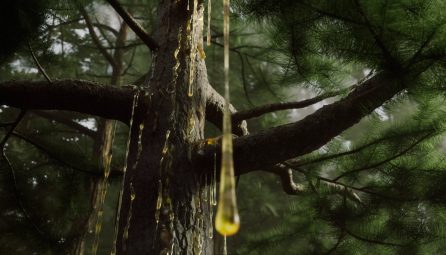
It (amber) forms of the
sap of a special species of pine, like cummis from
cherry-trees or tar from fir-trees; it is secreted due
to the abundance of moisture and it hardens from cold
or with time, or due to the influence of sea water,
when the risen waves carry it from the islands. It is
washed ashore so easily that it seems to be floating
in water but not sinking to the bottom. Our
forefathers called it tree-cummis, therefore,
they gave the name sucinum to it; the origin of
amber from pine species is also witnessed by the smell
of a rubbed pine and the fact that if kindled, it
burns in the same way like a smoldering pine sapwood,
like all conifers...”
Further on, the scholar
states that:
44. “... still at
present, on the other side of the River Padus, women
and commoners wear amber beads mainly as adornments
and partly as a remedy for the swollen glands and the
throat or palate pains”.
45. “From Carnuntum in
Pannonia the amber coast is 600000 Roman steps (about
888 km). Up to the present days is still alive that
Roman rider who was sent there (to the Sambian
peninsula) by Julianus, responsible for the games of
the Emperor Neron's gladiators, to provide for it
(amber). At that time, the messenger visited trade
stations commercia and shores. He brought such
a great amount of amber that it sufficed to decorate
the podium's fences and nets, protecting from wild
beasts, and the stretchers for the diseased. Even all
festive decorations were sparkling with amber. One of
the biggest pieces equaled 13 pounds (about 4,2 kg)...”
“Germani deliver amber
to Pannonia. At first it was delivered by Venedi
called Enedi by Greeks, because they lived in the
neighbourhood of Pannonia and later spread all over
the coast of the Hadrian Sea... In the Bay of Codanus
up to the Cape Cimbria (Skagends) there are a lot of
islands the largest of which is Scatinavia; its area
is still unknown. The part of already known island is
inhabited by Hilleviones, who call their island as
another world. No smaller is Aeningia. According to
other data, this country stretches up to the Vistula
and is inhabited by Sarmati, Vanedi, Sciri and Hirri.
The sea bay is called Cylipenus.
The island of Latris is
at its strait. Further beyond it, there is another bay
called Lagnus and it stretches to the end of Cimbria.
A narrow belt of earth stretches far into the sea and
forms a peninsula called Tastris”.
One finds it easy to
recognize the Baltic Eastern coasts in this laconic
description by Plinius, where the Roman rider visited
trade centres belonging to the inhabitants of Sambia.
What makes one wonder is a huge amount of amber
transported through all central Europe to Rome.
The mentioned fact
evidently proves that the “Amber Road” stretching
from the Vistula via Carnuntum up to Aquileia was
sufficiently provided with transport, and the barter
trade in amber was well organized.
According to Plinius:
“... neither white, which if burnt for a while
diffuses a pleasant smell, nor waxen yellow or dark (fulvis
major auctoritas) amber was more valued by the
Romans than transparent, slightly glossy (praeterquam
sinimio ardore flagrent), which made possible to
see looking through it not fire but only its
reflection...” “... The most favorite amber was of
a transparent Falernian wine colour. It was the most
expensive... Amber used to be made brighter (more
transparent) immersing it in goat's heated fat with
Anchusa {Anchusa
tietria root).'
CORNELIUS
TACITUS (55-120), a Roman historian, when
describing various nations and their geographical
situation in his work Germania [8], mentioned
Lithuanians' ancestors - Aestii, calling them Aestiorum
gentes.
45. “... On its right
coast, the Suebicum (Baltic) Sea washes Aestiorum
tribes, which have the same traditions and wear the
same clothes as Suebi, but their language shows a
closer affinity with Britanni. They worship gods'
mother and carry statuettes of wild boars, which serve
as the sign of their faith and the arms defending them
from everything and protecting even from enemies in
turmoil. They seldom use swords, more often - clubs.
They grow crops and other necessary plants more
diligently than the lazy Germani. They also make a
good search of the sea and are the only ones who
gather amber called glesum in shoals and on its
shores. As barbarians they did not investigate the
properties and origin of amber and were ignorant of
them. Amber had been lying among other things washed
ashore by the sea for long centuries until our luxury
gave a name to it. They do not use amber themselves:
gather its pieces, sell unprocessed and take a reward
wondering. It is easy, however, to perceive that amber
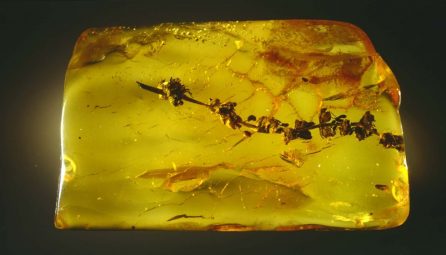
is tree resin, because some beetles and insects stuck
in hardening liquid remained there and in frequent
cases show through it. I suppose that dense woods and
forests, where incenses and balsam flow, can be found
not only in secluded Eastern localities but also on
Western islands and lands, where the liquid tree
resin, squeezed out by the rays of the hot sun, flows
(drops) to the nearest sea, and heavy storms cast it
to the opposite coast. If you try to test the
peculiarities of amber by sticking fire to it, amber
will flare up like a pine, spreading rich, fragrant
flame, but it will melt in an instant turning into tar
and resin...”
Some time later, the
great PTOLEMAEUS presents
a sufficiently clear picture of the south-east coasts
of the Baltic Sea in his maps.
VALERIUS
MARTIALIS (42-102), a known Roman poet of
epigrams, wrote epigrams about amber inclusions
[Martialis, in epigrammata. L. 2, p. 65; L. 5, p. 31;
L. 6, p. 15]. The descriptions of inclusions with a
little bee and ant are particularly picturesque. Later
on, these epigrams charmed Renaissance scholars, and
M. Lomonosov was the first to translate them into
Russian.
The description of an
inclusion with a little frog provokes a particularly
great interest. The epigram witnesses the production
of their imitations (Artificial inclusions with little
“frogs” and “lizards” reached us from N.
Gendel's book on the carvings of amber inclusions
(18th cent.)).
GALENUS
(about 129-199), a popular Roman doctor and scholar,
described in his book the application of amber in
medical practice. He used not only the curative
recipes of amber found in the works of earlier ancient
authors but also described folk medicine practice and
the application of amber for the treatment of various
ailments including by suggestion (Following Galenus'
recipe, the Prussian Duke Albrecht sent a piece of
amber to the sick Luther as a remedy for a stone
disease).
At the beginning of our
era, it was amber that strengthened economic and
commercial links with the provinces of the Roman
Empire. Under the rule of the Emperor HELIOGABALUS
(218-222) those links greatly weakened, and later,
with the fall of the Roman state, they were completely
broken off. The Baltic tribes searched for ways and
new means to re-establish trading relations with South
and Middle Europe and the Near East through the
mediation of Borysthenidae and Germanic tribes.
With a view of
re-establishing a trade with Italy, Aestii's
messengers went on a journey which, according to the
content of THEODORICUS'
letter was a success and the messengers were sincerely
welcomed.
M.
A. CASSIODORUS (Magnus Aurelijus
Cassiodorus, 6 th cent.), a Roman senator, THEODORICUS'
secretary, among other various official letters
presents the text of King THEODORICUS'
letter to Aestii in his Book 5. [9]
“... Therefore, we
cordially welcome you and say that we have gratefully
accepted the pieces of amber sent through your
messengers. We understand from the reports of your
messengers that amber as a very light substance is
cast ashore by a subsiding ocean wave. But the
messengers told us that you were ignorant of the
origin of amber: to tell the truth, you are the first
to get it, because your land simply donates it to you”.
As Cornelius (Tacitus)
informs: “... amber forms of the resin (ex-suco)
of the trees growing on more distant islands of the
ocean, therefore, it is called succinum. Due to
the heat of the sun, amber slowly hardens and when
sets, it becomes a soft transparent substance of fire
colour, sometimes with a shade of saffron. Polished by
the waves constantly washing the sand, it is cast to
your shores.”
This rare journey
through Central Europe forwards and backwards seems to
have been made between 523 and 525 along the old “Amber
Road”. With the fall of the Roman Empire, its
provinces experienced great social, economic and
ethnic changes. After the fall of the slave-owning
economic system, followed by stormy wars and migration
of nations, emerged small feudal states with a closed
natural economy. The majority of trade and crafts
centres of the antique world nearly or completely
discontinued their activities, and the links with
distant trade routes reachable by Aestii (Baltic)
tribes were broken off. Despite the fact that Aestii's
messengers traveled to the Rome Emperor Theodoricus
with a view of re-establishing trade relations, the
goal was not reached.
Later, barter trade in
amber continued through Borysthenidae tribes with the
Byzantium Empire and Arabian countries along Eastern
trade routes. Therefore, some written information on
the utilization of amber in those lands can be found
in more known scientific centres.
The most interesting
data for science from the early Middle Ages on amber
and other extracted resins is presented in the
treatise on the properties of precious stones by the
Uzbek encyclopaedist AL
BIRUNIUS of Choresmus (973-1048). He wrote
on the origin of amber: “AL KINSIUS (9th cent.
Arabian scholar) says that amber - resin is similar to
that of sanders (tree) secreted by some trees growing
on the bank of the River Scalabi. Everything what gets
into water hardens. And what gets on the ground - does
not.”
In this work amber is
compared with other species of extracted resin, e. g.
with African copal. In order to distinguish amber from
copal, it is necessary to heat them. The author
adduces some facts on byrmith and today's tree resin,
pointing out differences between various fossil
resins. He draws attention to the natural forms of
amber which perfectly witness that it was formed by
flowing resin e. g. in the form of drops and icicles.
The Arabian scientists AL
RASIUS (864-925) and IBN
SINA (980-1037), making use of the
information accumulated by ancient authors, presented
some new medical recipes. For example AL
RASIUM advised cleaning an eye (if a blade
gets in) with a rubbed plate of amber. Another Arabian
scholar JABIR HAYYAN
(HABER) greatly
valued curative properties of white (bone) amber, and
later the Dominican monk and scholar ALBERTUS
MAGNUS (1193-1200) described them. In his
well-known work De metallicis et mineralis [L.
5], on the basis of the information furnished by
ancient and Arabian scholars, the author described
various species of amber, the places of extraction,
and more thoroughly elucidated its curative
properties. The recipes presented by Albertus Magnus
spread over all the drugstores of European monasteries
or laboratories of alchemists.
The ancient and early
medieval information on amber was often used by the
investigators of later epochs
Amber in
the Evolution of the Baltic Culture
Amber was one of the
most important natural resources in the evolution of
the Baltic culture. Since the oldest times it was
known and exploited in various spheres of people's
activities. As an amulet or an adornment it adorned
the people of primitive and tribal community. And
later, with the expansion of intertribal barter trade,
amber became its important object. The neighbouring
Slavic and Celtic tribes took a liking to amber and
widely exploited it. Archaeological investigations
later acknowledged that amber following the routes of
intertribal barter trade reached ancient states' trade
centres of the Mediterranean Sea and Asia Minor. In
the slave-owners' palaces, besides other jewelry [II],
amber is mentioned as the symbol of wealth or value.
The white amber seems to have had the greatest demand
in the times of the Roman Empire [12], particularly
with the growth of the “Amber Road” stretching
from the Baltic shores through Karnuntum to Acquilea.
The Baltic archaeological monuments of the period
include considerably more Roman coins and other
imported articles witnessing a mutual character of
trade.
Later, following the
fall of the slave-owning Roman Empire and the ruin of
the old trade centres, amber through the trade
relations of Borysthenidae tribes reached Byzantium
and other Arabian countries. [13] Therefore, larger
Arabian science centres contain written facts on the
Baltic amber and other species of extracted resin.
[14] In the late Middle Ages, when the Order of
Crusaders gradually occupied almost the whole of
Baltic Eastern territory and appropriated the right to
collect amber, trading in amber ceased and amber was
mainly used in the sphere of religious worship: for
making rosaries and other small church attributes. It
was particularly abundantly used for incenses.
Only with the fall of
the Order of Crusaders, the 15th century East Baltic
countries more actively expanded their trade relations
with West European countries. Baltic amber provoked
attention again. In the land under the rule of
Crusaders, the first Prussian Duke Albrecht, who with
the intention of increasing his income gave permission
to expand guilds and shops for processing amber and
leased the rights to merchant to trade in amber,
gained the monopoly in amber. [15]
With the development of
natural sciences and the growth of the mining industry
manufactories under the influence of Renaissance
humanism and Reformation ideas, interest in the
investigations into amber grew again.
Besides books on general
mineralogy, even seven monographs only on amber
appeared in the second half of the 16th century. The
first monograph was published in Königsberg (now
Kaliningrad) in 1551. Its author doctor of medicine
from Wrocław (Breslau) Andreas Aunfaber was the first
to collect and accurately systematize all the
information of the period on amber in nineteen
chapters of the book. [16]
In respect of its
scientific standard, Aunfaber's work ranks among the
best monographs of the period, which due to its
methodological form came close to today's classical
scientific works. The beginning of the book is devoted
to a detailed survey of the names used for amber from
ancient times to the author's days. Besides ancient
and Arabic names, he includes for the first time a
dialectal name Gentar used by the local
Suduvians. Aunfaber presented 50 names for amber and
explained their meaning and origin.
In another chapter he
described the entire amber discovery and extraction
places known in that period. The author seems to have
communicated with local Suduvians and described the
processing of amber at great length.
He made the first
attempts to classify the species of amber according to
their morphological forms and the shades of their
trade gradation. The most valuable in Aunfaber's days
was white or “bone” amber mainly used in medical
practice.
On the basis of the
mineralogical classification of fossil resin worked
out by his contemporary Georgius Agricola (Georg
Bauer), Aunfaber refuted the views of ancient authors
on the vegetable origin of amber, considering them
wrong. He attributed amber to bituminous tar or
so-called “mountain wax” (ozocerite, chartite,
etc.) beside domerite, retinite and other resin of an
organic origin. The basis for his mineralogical
classification was not only a genetic link -
combustibility and a tar origin. To be sure, there
were other reasons as well. The mineralogists of those
days wondered that coalfields contained retinites and
“ambers” of fossil tar, the genesis of which has
not been fully explained up to now. Particularly rich
deposits of the mentioned substances were discovered
in brown coalfields. This was the reason which
stimulated the investigators to include all the fossil
tars into a joint resin group of a bituminous origin.
Therefore, in Aunfaber's opinion, amber (Bornstein) is
close to gagate (Agstein) another stone of a resin
origin. It is of a lustreless glitter and is easily
processed like amber (even today all the extracted
resin is sometimes called amber irrespective of its
geological age and the conditions of formation). [18]
The views of Agricola and Aunfaber on the origin of
amber witness the achievements in the sphere of
geology and mineralogy, which were followed by the
majority of the 16th-17th century investigators.
The second part of the
book refers to the curative properties of amber:
Aunfaber includes a lot of ancient medicine and
Arabian doctors' recipes, where “amber oil” and
“amber balsam” are used in medical practice beside
folk medicine incenses and massage. In Aunfaber's days
chemists were enough qualified to make amber acid and
amber salt used in medicine up to our times.
Thus, A. Aunfaber's
monograph not only generalized empirical data on the
investigations into amber but also formed a serious
scientific basis for its further studies. Original
hints of the morphological properties of amber as
drops (Tropfen) and other forms can be discovered in
Caspar Poiceraus' [19] study, where he makes an
attempt to analyse the process of amber formation.
Here the author highlights a diversity of amber
shades. In other books on mineralogy amber is
attributed to bituminous tar. For example C. Encelius,
following the views of ancient scholars, was of the
opinion that amber was formed of conifers' (Pinus)
resin, and gagate was bituminous tar or oil product.
[20]
Active studies gave an
incentive to researchers to accumulate mineralogical
collections, which served as the basis for the
formation of the collections with amber inclusions.
Conrad Gesneri [21] was the first to accumulate and
publish collections of inclusions, and his
contemporary Dan Hermann described artificial
inclusions. [22] At that period of time plant remains
hardened in Baltic amber, described in J. Wigandi's
book [23] published in 1590, also provoked a great
enough interest in them. Some time later, A.
Cesalpinaus (Andreas Caesalpinus De metallicis,
lib. II-III. Rome, 1696) in his book on mineralogy
quotes Tacitus' words about Baltic forests on a
Northern coast, copiously producing resin, which gets
into the sea at storms and is cast to the Sambian
coasts. A great attention to the study of natural
sciences is devoted in the works published in the 17th
century. It was the time when more than thirty works
and articles only on amber were written and published,
where, besides a fashionable critique of ancient
authors, the conclusions of Aunfaber's and other
researchers' works of the 16th century were presented
in various versions without a primary source. The work
of Anselm Boetii Boot, where he pinpointed a
mineralogical place of amber in the systematization of
extracted tar [24], distinguishes itself among works
describing a mineralogical classification of amber. He
thinks that the name “amber” includes the majority
of tars of different origin: some species of amber
found among coal originated from oil, those called ambra,
emerged from the fat of sea creatures, but the basic
part of those discovered on the Baltic shores are
hardened vegetable resin.
The extraordinary
professor of medicine Philip Jacob Hartmann presented
a big two-part work [25] devoted to the most
comprehensive description of amber. In his book (p.
291) he thoroughly examines the issues of amber: he
provides the data known by ancient and medieval
scholars, surveys the works of earlier authors and his
contemporaries. Hartmann was the first to get a deeper
insight into the morphological peculiarities of amber,
recommending them to apply for an artistic processing
of amber. Like the refutation of the natural origin of
amber, Hartmann advanced a new hypothesis concerning
the origin of amber based on practical observations,
which continued the theory of a mineralogical origin
of amber worked out by earlier investigators. Hartmann
is of the opinion that amber might have formed of tars
rich in oil and gas mixed with salts dropping in
liquid form on fossil remains of the trees. With the
evaporation of gas, this mass, as he assumed, would
harden and turn into amber. The shades of amber are
determined by the amount of salts in this mixture
(white amber contains the greatest amount of salt).
With respect to science,
Hartmann furnished greatly valuable data in his
description of amber extraction illustrated by an
impressive engraving. At the end of the second edition
of the work, the author attached the catalogue of
references, which has a great scientific
bibliographical value.
The early 18th century
witnessed the publication of several new articles.
[27] They deal with the remains of charred wood and
those of other vegetable origin found in amber
discovery places and amber itself. [28] On the basis
of these articles and other investigations, Caspar H.
Rappolt, a Königsberg University professor, came to
the conclusion [29] that amber might have formed at
the time of coast forest fires, when the masses of
resin flowing from resinous trees got to a damp forest
soil. Besides, the author assumes that resin would
also form of scorched tree trunks, which due to the
sun used to be particularly fluid, creating a
possibility for various insects and vegetable remains
to get into it. Later, resin would harden and sea
storms would cover it with sand dunes or wash to the
bottom. These conclusions deserved the attention of
even the 19th century researchers.
The first large-size
monograph on inclusions (in respect of its format and
press quality, a folio book) was published in 1742 in
Leipzig [30]. Its author N. Sendel, who lived in
Elbing (Elblong) for a long time, completed a valuable
collection in those days, featuring the specimen of
inclusions and morphological amber. Unfortunately, it
was lost in the fire of 1849. It is only the splendid
engravings at the end of the book that cast some light
on this collection.
The collection was
systematized according to the content of inclusions
into two major parts: inclusions with the remains of
insects and inclusions with vegetable, mineral
remains, and amber specimen with morphological
features. Whereas inclusions with insects were
classified into three appropriate subclasses: 1)
winged (flying) insects, 2) earth insects and 3) water
creatures, amber falsifications and unrecognized
inclusions.
The second part of the
book features inclusions with vegetable remains,
various inclusions of mineral origin (water drops in
amber), morphological specimen of amber with the
ornaments of inner textures and drops of amber. The
last table of illustrations includes the prints of
four Roman amber statuettes.
The book contains much
data on the earlier studies and descriptions of amber
inclusions, which together with the prints of
inclusions and other materials are greatly valuable in
the history of investigations into amber. Besides, the
book presents the descriptions of false inclusions
(known as far back as ancient times) and their
identification methods. Among later works on the
investigations into amber inclusions rank C. Linné's
works published in 1735, which deserve a great
scientific significance. They presented a general
flora and fauna classification system worked out by
the great Swedish naturalist. It served as the basis
for the systematization of inclusion collections. It
is worthy of mention that C. Linné was well stored
with facts [31] for the substantiation of the origin
of amber. In his report made in 1757 at the Petersburg
Academy of Sciences, M. V. Lomonosov argued
convincingly that amber is the resin of certain trees.
In his later published work [32] on the strata of
earth he elucidated the formation of amber at greater
length.
The 18th century
scientific works on amber were crowned with F. S.
Bock's monograph, which thoroughly demonstrated the
data collected by investigators throughout long
centuries and the carried out theoretical
generalizations of scientific data [33]. The prominent
professor of Königsberg University F. S. Bock
directed the work of the State Mineralogy Cabinet,
which possessed a valuable collection of the
morphological specimen of amber and inclusions. After
the study of all special literature on amber, Bock
collected valuable facts proving the processes of
amber formation, its chemical composition, physical
properties and a host of other facts concerning the
history of amber.
In his monograph the
author presented and generalized the whole of the data
accumulated in his investigations and observations.
The book concluded with a scientific catalogue of
amber collections. The merit of the catalogue lies in
its topical scientific significance. In comparison
with the publication of D. H. Paschke's, his
forerunner's collections of the Amber Cabinet [34], F.
S. Bock's catalogue was the publication of the
collections witnessing their great scientific virtue.
This book was the last
thorough description of amber, which seemed to
complete the cycle of the 17th-18th century monographs
on amber.
In the early 19th
century some articles on narrower problems of amber
emerged in special scientific literature on the study
of amber. The first cycle of articles devoted to the
solutions of economic goals in the sphere of amber
extraction and exploitation [35] was published by K.
G. Hagen. These articles contained a lot of historical
and statistical data from old chronicles and other
15th-18th century written sources about the gathering
of amber, various methods of its extraction, the
sorting and preparation of raw material for
production. They also specify the cases and
circumstances of the discovery of unique amber pieces.
A large-sized study on amber and other fossil resin
[36] was published in 1816 in Cologne. Its author, a
famous authority on natural science - Professor of
chemistry J. F. John, availing himself of the newest
achievements of chemistry, explored a chemical
composition of amber, its physical properties, the
preserved organic remains and other issues related to
the morphology of amber. His scientific conclusions
laid a solid foundation for the present-day
investigations on amber. Original investigations into
chemical properties of amber were continued by J. P.
Graffenauer [37], and later - by I. I. Berzelius [38],
whose published results greatly complemented J. F.
John's study. Quite a great contribution to scientific
studies of amber was made by scientific societies
established in two big centres for the studies of
amber: in Danzig (Gdansk) famous for its amber
processing masters since old times and Königsberg,
where investigators accumulated collections of amber
and other science-related things.
J. C. Aycke, the founder
of the Danzig Investigators’ Society, who
made up mineralogical collections of this Society,
explored amber for long years and generalized his
studies in his book published in 1835. [39] In his
work the author makes a lengthy description of the
morphological processes of amber. He also thoroughly
analyses the remains of fauna and flora preserved at
the time of the secretion of amber resin. He was also
the first to more comprehensively study the processes
of amber decay and its causes. At the end of the book
he presents a concise description of the sorting and
processing of amber.
A further attention of
the Danzig investigators was focussed on
palaeontological and palaeobotanical explorations of
the organic remains preserved in amber. G. K. Berendt,
a long-standing member of the Society, began his
studies of amber inclusions publishing a small book.
[40] Later in partnership with a group of other
investigators he published a big two-part work in two
volumes, summarizing his studies of amber inclusions
in the course of many years. [41] H. R. Goeppert and
A. Menge presented a monographic description of
vegetable amber inclusions after completing a detailed
study on anatomic composition of wood. The comparison
of their data with today's conifers led them to the
conclusion that amber resin was secreted by several
species of conifers. They offered a scientific
characteristic of the conifer wood remains preserved
in amber as well as the growing conditions of the
trees in the forests that had produced amber resin.
Wood remains among other various vegetable remains
preserved in amber became the focus of investigators'
attention. Upon a thorough examination of the wood
preserved in amber, H. Conwentz, director of the
Danzig Museum, wrote a monograph on Baltic forests
rich in amber. In this monograph he analysed only the
organically related to amber fragments of bark, wood
and other substances, which could secrete resin
themselves. In Conwentz's view, the remains of wood
preserved in amber with the properties of resinous
trees are the plants which secreted amber (succinit)
resin as a substance for the formation of amber
through centuries. The book is splendidly illustrated
with colour illustrations placed in 18 tables. All the
present-day descriptions of amber are based on the
conclusions of this monograph. The Danzig-based
scientists O. Helm and R. Dhams wrote a series of
articles devoted mainly to the mineralogical study of
amber and other fossil resins. They later appeared in
a periodical publication (1878-1927) of the Society.
The researches on amber were greatly influenced by the
Society of Physicists and Economists
established by the Königsberg naturalists in 1789. It
accumulated a large collection of mineralogical
fossils and announced its researches in the periodical
publication of the Society. Among the members of the
Society ranked such prominent researchers of amber as
G. Zaddach, G. Berendt, R. Klebs, A. Jentzsch and a
great many of others, who on the basis of private
collections and those owned by the Society founded a
Mineralogy Museum in 1822 as the centre for scientific
studies.
Ch. Darwin's theories
and the appearance of his On the Origin of Species
by Means of Natural Selection made a tremendous
impact on the completion of collections of amber
inclusions and their study. V. Siverdeker was the
first to draw attention to amber inclusions as a means
of casting light on Darwin's theory. It provoked an
enthusiastic collecting and study of amber inclusions,
joined by such outstanding scientists as G. Zaddach,
G. L: Mayr, H. Loew, G. Kunow and their numerous
followers. The periodical publication of the Society
(Schriften der Physikalisch-ökonomischen Gesselschaft
zu Königsberg) included quite a number of important
articles and monographic studies among which ranked H.
Loew's monographic study on dipterous birds [44], G.
L. Mayr's on ants [45], T. Cockerell's on hymenoptera
[46], G. Ulmer's on ephemera and the studies on other
etymological groups of inclusions.
Scientific data on a
geological composition of the strata rich in amber,
the formation of its deposits and other conclusions
concerning their discovery places were presented by G.
Zaddach [48] and other geologists, among them A.
Jentzsch [49], F. Kaunhowen (1914) and O. Linstow
(1922).
Following World War I,
the studies on amber were continued by the Königsberg
Mineralogy Museum, which was issuing a non-periodical
publication. [50]. Two monographs published by K.
Andrée [51] and A. Rohde [52] were also of
considerable interest.
In Lithuania amber
attracted scientist's attention only after World War
I. The first short book on amber was published in
1922. Its author Prof. P. Matulionis adduced some
concise facts about amber and its importance for
Lithuanians. The economist J. Kaskelis wrote a larger
monograph on the extraction of amber and economic
problems in 1933.
In the post-war years,
the investigations initiated by Kaskelis were
successfully continued by J. Dagys, who presented a
dissertation (1948) on economic issues of amber
(Unfortunately, this rather comprehensive manuscript
was not published). Later, on the basis of the works
by J. Kaskelis and J. Dagys, the economist J. Bubnys
wrote and published his dissertation (1957).
Amber in
the Light of Current Studies
A more explicit history
of the formation of amber was described in the
articles and monographs of the 19th century authors
due to the progress in the fields of geology,
paleontology, geography, history, archaeology,
chemistry and other branches of science. Our
contemporaries, exploiting the latest achievements in
the sphere of science and technology, specified a
number of aspects concerning a complex biography of
amber.
On the basis of the
mentioned facts, amber is regarded to be the extracted
tree resin without any crystallographic features,
containing 2-7% of amber acid in its composition. Such
is the Baltic amber called sucinites since
Plinius' times.
According to the data
presented by the science of geology, amber formed some
45-50 million years ago of the coniferous tree resin.
In scientific works such trees are often referred to
as Pinites succinitera. In Palaegone period the
forests with such trees must have grown in the
south-western valleys of the old Fenoskendinavian
continent.
With the great changes
in the climatic conditions (possibly due to the sea
transgression or the influence of the Gulf Stream),
the climate grew warmer and the amount of moisture
increased. In the result of a higher air temperature,
coniferous trees abundantly secreting resin grew
sickly and gave forest areas to subtropical
leaf-bearing trees, which could grow in a warmer
climate.
The secreted resin under
the conditions of a warm climate, due to the
evaporation of volatile terpenes would quickly harden
and later get to a damp forest soil together with wood
remains.
During frequent floods,
forest soils together with resin and wood remains were
washed away by water streams and carried to a
semiclosed sea bay by rivers and then deposited,
forming glauconitic sea sand sediments called the “Blue
Soil”. Over millions of years the resin affected by
various physical and chemical environmental factors
underwent changes turning into the Baltic amber. Later
climatic changes more than once altered the map of
land continent and the sea, and the washed away amber
again traveled by sea, forming various deposits of
sediments in a much wider geographical area. The basic
places of the Baltic amber discovery, however,
remained in the Sambian peninsula.
One can find valuable
scientific facts about amber in the publications of
foreign researchers such as J. H. Langenheim, C. W.
Beck, G. O. Poimar, R. Zadziewski, R. Schuüteri, V.
G. Kovaliov and others.
In Lithuania,
comprehensive researches into the geological and
mineralogical properties of the Baltic amber were
carried out by Dr. V. Katinas, who generalized them in
his monograph [53] and in his later published work.
[54] On the basis of the copious factual data of the
conducted researches, he formed new aspects of amber
genesis, thoroughly featuring the stratigraphy of the
deposits of the South Baltic amber as well as their.
lithological characteristics.
Besides, upon a detailed
analysis of the fascial conditions under which the
places of amber discovery were formed V. Katinas
continues geological and morphological researches on
amber and other extracted resin. At present, they are
being continued by other researchers
palaeontropological researches on amber and other
fossil resin inclusions. Among numerous scientific
publications, the works of Dr. S. Podenas, an
entomologist of the Vilnius University Department of
Zoology, distinguish themselves by their maturity.
With the expansion of the industry of amber adornments
and souvenirs, an interest in this unique nature
creation has not decreased in Lithuania. The opening
of the Amber Museum in Palanga in 1963 was followed by
a methodical completion of amber collections. A great
part of these collections include morphological,
geological and unique specimen of amber for its
further study and the elucidation of various issues in
the sphere of natural sciences. Another part of the
museum's collections consists of amber articles and
the means of its processing, reflecting various
historical periods. A particularly valuable in a
scientific respect is the collection of archaeological
amber finds, the accumulation of which goes back as
far as the late 19th century.
On the basis of amber
collections, the museum features a permanent
exposition, which has become a popular centre for the
information on amber.
References
1 The Odyssey of Homer.
Harper Perennial, 1991. Translated by R. Lattimore.
2 Trenceni-Valdapfelis
I. Mythology. Vilnius, 1972, p. 151 (in Lithuanian)
3 Thalete. Laevius, in
vitis philosophorum. B. v., b. m., L. I.
4 Plinius. Naturalis
historia. Basiliae, 1530, L. 37, p. 33.
5 Ibid.
6 Ibid., p. 40.
7 Cooke I. Natural
history of lac, amber and myrrh. London, 1770.
8 Tacitus K. Selected
Works. Vilnius, 1972, p. 29-30 (in Lithuanian)
9 Cassiodori. Senatoris
variare. B. v., b. m., kn. 5, d. 2.
10 Clark J. Prohistoric
Europe. B. v., 1952, p. 261-262.
11 Homer. Odyssey. V.,
1979, p. 61, 277, 332 (in Lithuanian) The Odyssey of
Homer. Harper Perennial, 1991. Translated by R.
Lattimore
12 Michelbertas M.
Trading Relations with the Roman Empire. In the book:
Michelbertas M., Tautavicius A., Kunciene O. Trading
Relations of Lithuania's Inhabitants in the 1st-13th
Centuries. Vilnius, 1972, p. 73-78 (in Lithuanian)
13 Lewicki T. Čcrivains
arabes du siécle IX-e au XVI-e, traitant de l'ambre
jaune de la Baltique et de son importation en pays
arabes. - Kn.: Folia orientalia. Krakow, 1962, p. 39.
14 Biruni. Collection of
Data on the Identification of Precious Stones.
Moscow., 1963, p. 470 (in Russian)
15 Eldit H. Das
Bernstein-Regal in Preussen. - Altpreussische
Monatsschrift, 1868 Bd. 5, p. 585-586.
16 Aurifaber A. Succini
historia. Königsberg, 1551.
17 Agricola G. De nature
fossilium. Basileae, 1546.
18 Langenheim J. H.
Amber: A botanical inquiry. - Science, 1969, vol. 163,
Nr. 3874, p. 1157-1169.
19 Peucerus C.
Propositiones de origine et causis succini Prussiaci.
Wittenberg, 1555.
20 Encelius C. De re
metallica h. e. de origine, varietate et natura
corporummetallicorum, lapidum, gemmarum et aliarum...
Francofurti, 1557, L.3.
21 Gesneri C. De rerum
fossilium, lapidum et gemmarum figuris. Tiguri, 1565.
22 Hermann d. De rana et
lacerta succino Prussiaco insitis. Cracau, 1580;
Rigae, 1600.
23 Wigandi J. Vera
historia de succino Borussico, de alce Borussica et de
herbis in Borussia nascentibus...Jenae, 1590.
24 Boetii Boot A.
Historia gemmarum et lapidum. Lugduni Batavorum, 1647.
25 Hartmann P. J.
Succini Prussici physica et civilis historia, cum
demonstratione ex autopsia et intimiori rerum
exsperientia deducta. Francofurti, 1677.
26 Hartmann P. J.
Succinecta, succini prussici historia et
demonstratio.Berolini, 1699, p. 337-364.
27 Observation von der
Matrice, oder Geburts-Lage des Bernsteins: Sammlung
von Natur-und Medizin-Kunst- und Literatur
Geschichten, V. Versuch, Sommer-Quartal, 1718.
28 Breynii P. J.
Observatio de succinea gleba plantae cujusdam folio
impregnata rarissima. - Philosophical transactions of
London, 1728, vol. 34, Nr. 395.
29 Rappolt C. H. De
origine succini in littore sambiensi. Regiomonti,
1737.
30 Sendel N. Historia
succinorum corpora aliena involventium et naturae
opere pictorum et caelatorum... Lipsiae, 1742.
31 Linn'e C Fossilien
Bernsteinerungen. - Kn.: Linn'e C Natursystem des
Mineralreichs. Nürnberg, 1778. T. 3, p. 442-486.
32 Lomonosov M. B. On
Earthly Strata. 1761 (in Russian)
33 Bock F. S. Versuch
einer kurzen Naturgeschichte preussischen Bernsteins
und einer wahrscheinlichen Erklärung seines
Ursprungs. Königsberg. 1767.
34 Paschke D. H.
Moralische Gedanken bey einem Börnstein-Cabinett.
Königsberg, 1742.
35 Hagen K. G.
Geschichte der Boernsteingräbereien in Ostpreussen
und besonder der auf bergmännische Art
veranstalteten. - Beiträge zur Kunde Preusgens, 1824,
Bd. 6, H. 2, p. 200-227.
36 John J. F.
Naturgeschichte des Succins, oder de Sogenannt
Bernsteins. Köln, 1816, Bd. 1.
37 Graffenauer J. P.
Histoire naturelle, chemique et technique du succin ou
ambre jaune. B. v., 1821.
38 Berzelius J. J.
Traité de chemie. B. v., 1839.
39 Aycke J. C. Fragmente
zur Naturgeschichte des Bernsteins. Danzig, 1835.
40 Berendt G. C. Die
Insekten im Bernstein. Danzig, 1830.
41 Berendt G. C. Die im
Bernstein befindlichen organischen Reste der Vorwelt.
Berlin, 1845-1856, Bd. 1-2.
42 Goeppert H. R. Menge
A, Die Flora des Bernsteins und ihre Beziehungen zur
Flora der Tertiärformation und der Gegenwart. Danzig,
1890.
43 Conwentz H.
Monographie der baltidchen Bernsteinbäume. Danzig,
1890.
44 Loew H. Über die
Dipterenfauna des Bernsteins. Berlin, 1861.
45 Mayr G. L. Die
Ameisen des baltischen Bernsteins. - Beiträge zur
Kunde Preussens, 1868, Bd. 1, p. 1-102.
46 Cockerell T. D.
Descriptions of Hyenoptera from Baltic amber. -
Schriften der Physikalisch-ökonomischen Gesellschaft
zu Königsberg, 1904, Bd. 50, H. 1, p. 1-20.
47 Ulmer G. Trichopteren
des baltischen Bernsteins.- Beitrage zur Naturkunde
Preussens, 1912, Bd. 10.
48 Zaddach G. Über die
Bernstein-und Braunkohlenlager des Samlands. -
Schriften der Physikalisch-ökonomischen Gesellschaft
zu Königsberg, 1860, Bd. 1, H. 2, p. 1-45.
49 Jentzsch A. Beiträge
zur Kenntniss der Bernsteinformation. - Schriften der
Physikalisch-ökonomischen Gesellschaft zu
Königsberg, 1877, bd. 17, H. 2, p. 101-108.
50Andree k.
Bernsteinforschung einst und jetzt. - Bernstein,
Forschungen, 1929, Bd. 1.
51 Andree K. Der
bernstein und seine Bedeutung... Königsberg, 1937.
52 Rohde A. Das Buch von
Bernstein. Königsberg, 1941-
Katinas V. Amber and
Amber Sediments in the South Baltic Region. Vilnius,
1971, p. 155 (in Russian)
Katinas V. Baltic Amber.
Vilnius, Mokslas Publishers, 1981, p. 112, ill (in
Lithuanian)
Translated by Laimute
Zabuliene
Prepared by:Budrys. R.
REVIEW OF THE LITERATURE ON AMBER // Baltic Amber / ed.
by Adomas Butrimas. - Vilnius: Publishing Office of
Vilnius Academy of Fine Arts, 2001. P. 261-272.